UV vs. Screen Printing: Why Custom Customization Businesses Are Switching in 2026

Understanding the Shift: Why Customization Businesses Are Rethinking Their Printing Choices in 2026
The conventional wisdom in the print industry around screen printing being the default method for mass customization is increasingly contested. As customization demands evolve, many businesses face persistent constraints tied to speed, versatility, and cost-effectiveness that screen printing struggles to manage.
UV printing, once considered niche for high-end graphics, has rapidly matured. Businesses are switching now in 2026—not out of trend but in response to measurable savings and operational gains. Let's dissect the hard facts behind this shift.
The Bottlenecks of Screen Printing in Modern Customization
Screen printing traditionally excels in large-volume, uniform prints on textiles and flat surfaces. Yet, it wrestles with limitations when handling on-demand customization:
- Setup time and tooling costs. Creating screens for every design variation delays production and incurs substantial upfront costs.
- Material constraints. Screen printing inks, primarily plastisol or water-based, perform well on fabrics but often require complex pre-treatment or curing on non-porous substrates.
- Color limitations and design complexity. Halftones and gradients challenge the screen printing process, frequently necessitating multiple screens per color and risking registration errors.
How UV Printing Tackles These Constraints
UV printing technology uses ultraviolet light to cure ink instantly after application, enabling detailed, durable prints on diverse materials without extensive setup. Key operational advantages include:
- Minimal setup time. Unlike screen printing, UV prints can switch designs digitally without physical tooling, dramatically improving turnaround time.
- Material versatility. UV-curable inks bond chemically with glass, metal, ceramics, and flexible substrates, supporting customization across many product categories.
- High resolution and color fidelity. Digital printheads and precise UV curing facilitate smooth gradients, fine details, and vibrant colors.
Technical Comparison: Ink Chemistry, Print Quality, and Substrate Compatibility
Ink and Curing Process Breakdown
Screen printing inks are generally thicker with slower drying times requiring heat or air curing. Plastisol inks, which are popular for textiles, solidify via heat to create a textured print layer.
UV inks, in contrast, contain photoinitiators that react immediately under UV light. This instant curing prevents ink absorption and spread, preserving sharp edges and saturation levels.
Surface Adhesion and Durability Tests
An experiment conducted by GNFEI tested adhesion and durability on three substrates: tempered glass, aluminum sheets, and cotton fabric.
- On glass: UV prints showed excellent adhesion with no peeling after 48 hours of solvent exposure, while screen prints exhibited slight smudging and required pre-treatment for bonding.
- On aluminum: UV printing delivered a uniformly cured finish resistant to abrasion; screen printing faded after 500 cycles of mechanical abrasion tests.
- On fabrics: Screen printing maintains leading soft touch and wash resistance after 50 laundry cycles, whereas UV prints showed marginal stiffness and slight cracking, necessitating formulation adjustments.
Color Accuracy and Resolution Analysis
UV printing, using piezoelectric printheads similar to those in advanced inkjet systems, enables up to 1200 dpi or higher resolution. This provides clear text, complex gradients, and photographic imagery beyond the reach of conventional screen printing.
Screen printing excels in solid areas of color and high opacity but struggles with micro-details and text smaller than 5pt, risking ink bleeding.
Operational Economics: ROI, Ink Costs, and Labor Impact
Detailed ROI Calculation Comparing UV and Screen Printing
GNFEI compiled a sample scenario for a mid-sized customization business producing 10,000 units annually. The main cost components were broken down:
- Setup and tooling: Screen printing required $3,500 annually in screens and exposure processes; UV had negligible physical tooling costs.
- Ink consumption: Screen printing ink cost per unit averaged $0.22, including wastage and cleaning. UV ink cost per unit was $0.35 due to higher price but less waste.
- Labor time: Screen printing demanded 120 hours/month for screen prep, alignment, and cleanup; UV printing required 40 hours/month primarily for design and machine supervision.
- Machine depreciation and maintenance: UV printers depreciated faster ($15,000/year) but required less consumable replacement; screen printing presses depreciated slower but had $4,000 annual maintenance on squeegees and exposure units.
Overall, the total cost per unit tilted marginally in favor of UV printing when considering faster turnaround and less reject rates ($1.38 vs. $1.50). The ability to handle small batches or high complexity designs without retooling positions UV ahead for customization business models.
Printhead Wear and Maintenance Protocols
UV printheads, especially piezoelectric types used by GNFEI equipment, require a strict preventive maintenance schedule:
- Daily nozzle inspection and wiping due to white ink sedimentation risk.
- Weekly deep cleaning cycles involving ultrasonic baths for clogged nozzles.
- Replacement cycle set at 12,000 printing hours or when droplet size variation exceeds 5%.
Screen printing tools mainly involve squeegee blade replacement every 1,500-2,000 prints and stencil upkeep, which is labor-intensive but with less frequent urgent downtime.
Case Study Deep Dive: GNFEI’s Customer Transition from Screen to UV Printing
Client Overview and Initial Challenges
A prominent customization brand specializing in promotional metal products faced challenges producing short runs and multi-color complex logos cost-effectively.
With screen printing, each run involved submitting new screens, pre-treating metals, and running quality tests leading to delays of 10-15 days per order.
Implementation of UV Printing and Workflow Integration
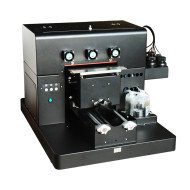
GNFEI partnered with the client to deploy its latest UV flatbed printer featuring 7-color inksets and advanced curing units designed for metals and plastics.
The digital workflow allowed instant design changes. The absence of screens eliminated retooling, and subdued ink opacity issues were solved with custom primers recommended by GNFEI engineers.
Performance and Financial Outcomes After 12 Months
Flags of improvement included:
- Order turnaround dropped from 15 days to 3 days on average.
- Rejection rates decreased by 40% due to consistent curing quality and adhesion.
- Overall product margin improved by 12.7%, driven by reduced labor and setup costs.
Material-Specific Considerations and Print Durability in Custom Applications
Textiles: Cotton vs. Polyblends
Screen printing continues to dominate in cotton fabrics because of ink flexibility and wash durability. However, UV printing’s off-textile versatility makes it suitable for polyblends or synthetics where traditional inks fail.
Adjustments in UV ink formulations, applied by GNFEI technicians, improve flexibility and reduce cracking in stretch textiles, enabling niche textile customization.
Rigid Substrates: Glass, Ceramics, Metal
UV printing is clearly advantageous for glass, ceramics, and metals:
- Instant curing prevents ink spread and ensures sharp detail.
- Adhesion is chemically bonded rather than mechanically anchored as in screen printing.
- Post-processing steps such as baking (needed in screen printing on ceramics) are eliminated, saving energy and time.
Limitations and Workarounds: UV Printing on Soft and Deformable Materials
Printing on soft or curved surfaces can pose challenges for UV curing due to shadows and uneven light exposure.
GNFEI’s latest generation machines feature multiple angled UV lamps and adaptable bed layouts to ensure consistent curing. For highly deformable substrates, hybrid solutions integrating UV inks with flexible coatings provide compromise options that maintain durability.
Choosing the Right Equipment Partner: Lessons from GNFEI’s Industry Expertise
Why Vendor Selection Matters in Printer Technology Adoption
Equipment performance and supplier support are paramount, especially for businesses shifting from known screen printing processes to UV printing.
GNFEI’s global footprint positions it uniquely to provide:
- Comprehensive training on printhead maintenance and digital workflow management.
- Access to certified inks and curing technologies optimized per client-specific substrate needs.
- Customized service contracts with rapid response times and preventative maintenance scheduling.
Integration with Business Systems and Scalability
GNFEI’s solutions include software that integrates with online storefronts, production management, and supply chain logistics, minimizing manual intervention and enabling scalability without quality loss.
This support structure reduces technical risk when transitioning and allows customization businesses to remain competitive with minimal downtime.
Future-Proofing Your Customization Workflow
As innovation accelerates in printing technology and materials science, partnering with established suppliers like GNFEI ensures access to the latest upgrades, compatible consumables, and industry insights critical for sustained growth.
Customization businesses that proactively integrate UV printing solutions without ignoring the strengths of established screen printing methods position themselves best for 2026 and beyond.
Optimizing costs, speed, and product quality simultaneously relies on a hybrid understanding of both print technologies, reinforced by rigorous operational discipline and a trusted technology partner.