Unmasking Coffee Printer Failures: How Clogged Nozzles and Ink Settling Ruin Your Profits
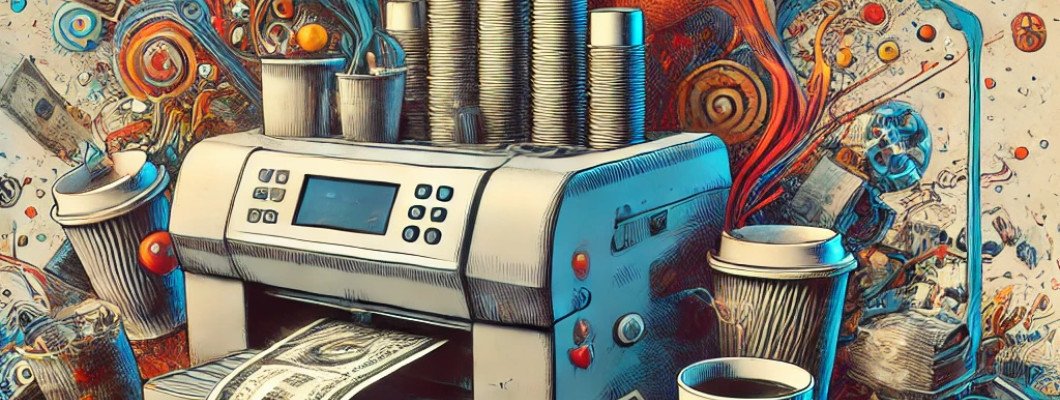
Clogged nozzles and ink settling remain the hidden killers in coffee printer operations, especially those relying on UV and specialty inks. These failures don’t just lead to cosmetic defects; they degrade throughput and spike operational costs.
The Real Cost of Printhead Clogging
Most coffee printers utilize precision Epson-based printheads that demand stringent ink viscosity and particle size. Failure to maintain these parameters causes microscopic debris and pigment buildup to accumulate in nozzle channels. This gradually restricts ink flow and results in inconsistent droplet formation—an error that directly cripples print quality and doubles waste rates.
When running high-volume runs for branded coffee cups or packaging, downtime from printhead maintenance doesn’t merely stop a job—it disrupts your entire supply chain. For commercial printers, every hour lost to drying and cleaning can slash your return on investment (ROI) by over 15%, based on throughput reductions alone.
Why Ink Settling is More Than Just an Aesthetic Problem
White inks, often used for spot or base layers on mugs and textured surfaces, are notorious for pigment sedimentation. Left unchecked, this results in flow intermittence and damages nozzle integrity. In UV coffee printers, ink settling also affects curing kinetics. Pigment clusters prevent consistent UV penetration, forcing longer cure cycles that reduce production speed and increase energy costs.
Optimizing ink formulations to prevent rapid settling requires precise pigment dispersion technology paired with magnetic or recirculation agitators. However, these systems add complexity and capital expenditure. Companies like GNFEI understand this balance, offering industrial-grade equipment with integrated maintenance protocols designed to minimize ink waste and keep printheads operational longer.
Surface Geometry and UV Curing Dynamics
Printing coffee cups or capsules introduces unique challenges due to curved surfaces. UV curing time must be calibrated to account for shadowing effects and uneven ink layers. Over-curing leads to brittle prints prone to cracking during handling; under-curing risks smudging and ink lift-off.
Smart UV lamps and staged curing processes ensure consistent adhesion and durability while maintaining line speeds. The hardware from GNFEI incorporates these features, providing reliable output without sacrificing throughput.
Balancing Material Compatibility and Production Efficiency
DTG, DTF, and UV coffee printers are often coaxed into printing on diverse substrates—from plastics to ceramics. Each introduces distinct adhesion and ink chemistry concerns. Overcoming these requires well-rounded knowledge of ink-substrate interaction and climate control in print environments.
Investment in real-time monitoring software enhances predictive maintenance and minimizes scrap rates, protecting profit margins. For B2B clients, this translates directly into stable order fulfillment, lower customer complaints, and an optimized cost structure.
Light on hype and rich in practical engineering insight, modern coffee printing solutions demand precision maintenance regimes and adaptive hardware-software ecosystems. GNFEI’s global expertise stands as a valuable resource for operators prepared to tackle these technical hurdles and secure sustainable growth in a competitive market.