Scaling Print Throughput with A3 DTG and DTF Technology for Business Growth

The Industrial Reality of Scaling High-Volume T-Shirt Printing
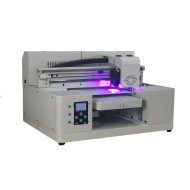
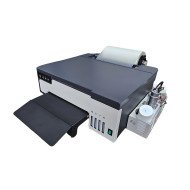
The operational challenge for scalable businesses adopting A3 Direct-to-Garment (DTG) and Direct-to-Film (DTF) printers lies in balancing throughput demands with labor and maintenance constraints. These machines, capable of producing high-detail prints on demand, often face bottlenecks when incorporated into medium- to large-scale workflows aiming to fulfill hundreds or thousands of pieces daily. The mechanical and software design of A3 DTG and DTF printers imposes physical limits on prints per hour, compounded by downtime for maintenance and consumable replenishment.
Consider a print shop transitioning from manual screen printing to automated DTG/DTF setups. Although the print quality and substrate versatility improve, the incremental labor required for pre-treatment, loading/unloading garments, and quality checks can dilute productivity gains. The challenge becomes evident with A3-sized prints: the increased print area relative to A4 presses demands longer print times per piece, reducing throughput unless offset by parallel machine operation or automation.
Additionally, each print cycle includes drying or curing phases critical to ink adhesion and color fidelity, which add hidden time costs and increased energy consumption in climate-controlled environments. Managing these factors requires a nuanced understanding of machine capability versus actual operational output, labor scheduling, and maintenance planning.
Hardware Capability against Practical Limits in Throughput
A3 DTG and DTF printers generally operate at 360–400 dpi resolution using piezoelectric printheads ejecting ink droplets between 10–20 picoliters (pl), with print speeds ranging from 1.5 to 3 minutes per standard full A3 print. The ink chemistry—water-based pigment for DTG and specialized adhesives for DTF—further impacts drying time.
The thermal and mechanical tolerances of printheads must be balanced for sustained output. For example, a printhead rated for 40 million nozzles firing cycles may degrade after roughly 2000 hours of continuous operation under high humidity and dust conditions common in textile printing environments. To maintain consistent throughput, frequent nozzle cleaning cycles, which can take 2-5 minutes each, are mandatory, reducing net productivity.
Comparing two operational modes, single-pass versus multi-pass printing, reveals trade-offs:
| Parameter | Single-Pass Printing | Multi-Pass Printing |
|---|---|---|
| Print Speed per A3 Shirt | ~90 seconds | ~180 seconds |
| Print Quality (dpi) | Lower (300-360 dpi) | Higher (600-720 dpi) |
| Ink Usage Efficiency | High Waste | Optimized Droplet Placement |
| Maintenance Frequency | Lower | Higher |
| Practical Throughput (shirts/hour) | ~40 | ~20 |
Operational managers must assess their throughput target and quality requirements to determine the preferred printing strategy. Multi-pass printing produces higher fidelity at the cost of halving throughput and requiring more frequent maintenance.
Labor Cost and Automation Impact on Scaling
Labor plays a critical role in the economics of scaling A3 DTG and DTF printing machines. The manual steps of pre-treatment application, drying, garment placement, and post-print curing demand semi-skilled operators. Each step introduces variability and potential bottlenecks. Automation integration, such as conveyor systems or robotic garment handlers, can elevate throughput but at steep initial capital expenditure and increased complexity in setup and maintenance.
Labor efficiency gains can be approximated by a ratio comparing prints per labor hour. In manual setups, one operator may be limited to handling 15-25 prints per hour considering handling and quality control, while automation can increase throughput to 50-75 prints per labor hour. However, automation demands more rigorous environmental control (temperature, humidity) and preventative maintenance schedules to avoid downtime, which can offset gains if not managed meticulously.
Maintenance Costs and Workflow Bottlenecks
Maintenance frequency for printheads, feeder rollers, and ink delivery systems scales with throughput. Estimated mean time between failure (MTBF) for key components is around 1500 hours in standard conditions but can be reduced by high particulate or volatile solvent environments common in apparel workshops. Preventative maintenance cycles involving printhead nozzle checks, ink line flushing, and mechanical calibration typically consume 30-60 minutes per shift, reducing net operational time by 10-15%.
Consumables such as pre-treatment fluids, ink cartridges, and transfer films for DTF also introduce recurrent costs that may escalate with throughput, influencing operating expense (OPEX) budgeting. Factoring machine depreciation over 3-5 years and maintenance contracts yields a comprehensive cost-per-piece metric critical for business scalability assessments.
Infrastructure Integration Challenges in Scaling Setups
Deploying multiple A3 DTG and DTF printers in a production line necessitates addressing power, ventilation, and spatial requirements. Typical A3 printer power consumption ranges from 500 to 750 Watts per unit during active printing and up to 900 Watts during curing or drying stages. Managing thermal output and air quality (particularly solvent vapor exhaust for DTF adhesives) requires enhanced HVAC infrastructure, which may be underestimated during initial setup.
Rack density and floor space optimization must consider operator access and material flow. A modular layout integrating pre-treatment stations, print areas, and curing ovens can mitigate inefficiencies but demands precise workflow engineering. Real-time production monitoring systems are beneficial for detecting bottlenecks and scheduling maintenance during low-demand periods.
Scenario Analysis of Business Use-Cases
Case 1 Medium-Scale Custom Apparel Start-Up
With a monthly production goal of 2,000 shirts, a single A3 DTG printer operating with multi-pass mode limits production to roughly 600 pieces/month accounting for maintenance and labor constraints. Adding a second printer or shifting to single-pass mode doubles output but impacts print quality and increases ink waste. Investing in partial automation around loading/unloading would raise output to target levels but requires upfront CAPEX of about $15,000.
Case 2 Established Print-On-Demand Platform
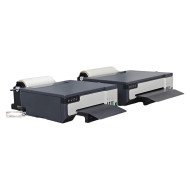
In this high-velocity environment targeting 10,000 prints monthly with varied graphics and frequent color changes, a bank of five A3 DTF printers configured for single-pass printing balances throughput and quality. The maintenance load increases, necessitating a full-time technician and automated feeder mechanisms. Despite higher OPEX, the flexibility and speed justify infrastructure upgrades including expanded HVAC and power delivery.
Case 3 High-End Boutique with Emphasis on Precision
Prioritizing print quality and color accuracy over volume, this business uses a single A3 DTG printer in multi-pass mode with skilled operators performing manual pre-treatment and curing. Throughput caps at 500 shirts monthly, but premium pricing offsets lower volume. Maintenance is scheduled conservatively to avoid downtime during critical production cycles.
Expert FAQ
1. How does ink droplet size affect print durability in DTG versus DTF?
Smaller droplets (~10 pl) in DTG enable finer gradients and fabric penetration but can degrade faster under abrasion due to lower ink layer thickness. DTF’s adhesive-based transfer films deposit thicker ink layers, improving durability but reducing micron-level detail.
2. What are the implications of continuous nozzle clogging on machine uptime?
Frequent nozzle clogs increase cleaning cycles, leading to 10-15% lost productivity. Long-term, it accelerates printhead degradation, pushing maintenance costs higher and shortening asset lifespan.
3. How do environmental factors influence print quality and maintenance?
Humidity affects ink drying speed and adhesion in DTG, requiring climate control in production areas. Dust and particulates precipitate nozzle clogging and mechanical wear, increasing maintenance frequency.
4. Can throughput be scaled linearly with machine count?
No. Beyond a certain point, workflow bottlenecks—such as pre-treatment station capacity—limit linear scaling. Labor and infrastructure constraints also create diminishing returns without process automation.
5. What role does post-print curing play in operational scheduling?
Curing time is critical for ink fixation and often exceeds printing time, necessitating buffer storage or parallel curing ovens to prevent throughput delays. Efficient scheduling minimizes idle time between printing and curing stages.
Strategic Verdict on Scaling with A3 DTG and DTF Printers
Scaling production with A3 DTG and DTF printers demands a systemic approach integrating hardware capability, labor efficiency, maintenance discipline, and infrastructure planning. While the machines enable high-quality prints with flexibility on fabric types and designs, physical printing speeds and post-processing requirements impose throughput ceilings. Businesses seeking to grow must carefully evaluate trade-offs between print quality and throughput, investing strategically in automation and environment controls to mitigate hidden bottlenecks.
Future improvements are likely in printhead durability and ink chemistry, potentially reducing maintenance frequency and drying times, but operational complexities will remain significant. This technology is best suited for scalable businesses with disciplined workflow engineering rather than purely volume-driven mass production lines.