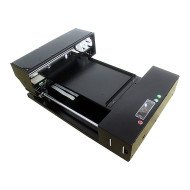
Operational Constraints and Longevity Challenges in the PrintInd Ultra Portable Handheld Inkjet Printer

The Industrial Reality of Portable Inkjet Solutions
Within industrial and field operations, precision handheld inkjet printers such as the PrintInd Ultra pose unique operational challenges. While portability facilitates onsite printing in constrained spaces, it simultaneously imposes significant limitations on asset longevity and maintenance scheduling. In a manufacturing environment with unpredictable throughput, handheld units frequently encounter variable duty cycles that deviate starkly from mandated maintenance intervals. For example, a typical printhead rated for 8,000 continuous nozzle cycles per minute can suffer accelerated wear if subjected to frequent startup/shutdown cycles, a common occurrence in mobile handheld deployment.
Field operators often grapple with fluctuating ambient conditions—temperature swings from 5°C to 40°C and humidity variations of 20-80% RH—all of which impact ink viscosity and jetting reliability. These environmental factors compound degradation mechanisms intrinsic to microelectromechanical system (MEMS) printheads, such as nozzle clogging and piezoelectric element fatigue. Operational bottlenecks arise when print quality degradation mandates premature downtime. Moreover, asset depreciation is driven not solely by physical wear, but also by evolving ink chemistry compatibility and firmware obsolescence, further reducing usable lifespan.
In industrial workflows where uptime correlates directly with output yield, understanding the nuanced interplay between operational parameters and hardware resilience becomes critical. This reality frames the ultimate decision matrix for purchasing and lifecycle management of handheld inkjet printers beyond initial acquisition cost.
Printhead Technology and Failure Modes
The PrintInd Ultra utilizes a piezoelectric MEMS printhead array with nozzle diameters approximating 50 microns. Ink droplet volumes are typically 10-12 picoliters, optimized for medium-resolution marking at 300 dpi. The piezoelectric actuator's displacement amplitudes decrease monotonically with cycling due to dielectric and mechanical fatigue, limiting the theoretical MTBF (mean time between failures).
Mathematically, the fatigue life L can be approximated by L = K/(N^b), where N is the nozzle actuation frequency, b is a material fatigue exponent (~0.1-0.3), and K is a constant linked to actuator design. High-frequency intermittent firing, common in handheld use, results in uneven stress distributions and microcracks initiating at nozzle interfaces. This results in increased dropout rates and printhead channel clogging.
Comparatively, stationary industrial inkjet printers operate under constant environmental control with forced ambient conditioning, significantly reducing ink drying times and evaporation-induced clogging. The portable design sacrifices this mitigation, requiring enhanced maintenance protocols.
Ink Chemistry Impact on Longevity and Maintenance
The PrintInd Ultra's ink formulation includes solvent-based pigments with rapid drying properties to facilitate immediate substrate adhesion. However, solvent evaporation in small-volume ink reservoirs accelerates ink viscosity shifts, which escalate nozzle clogging probability. Offline viscosity measurements show a 15-20% increase after 2 hours of idle time at 25°C.
Mathematically, viscosity η can be modeled as η(t) = η_0 * e^{λ t}, with λ representing the evaporation rate constant, empirically measured near 0.08 per hour under typical operational conditions. This exponential increase demands frequent purging cycles, adding to operational downtime and consumable costs.
Operational Throughput Versus Maintenance Burden
Throughput rates in handheld portable inkjet printers are constrained by both mechanical and chemical factors. While the PrintInd Ultra can theoretically achieve marking speeds of up to 90 mm/s at 300 dpi, practical throughput is throttled by required cleaning cycles, warm-up periods, and user handling ergonomic limits.
A comparative analysis reveals that continuous printing beyond 15 minutes without intermediate purging incurs a risk increase of over 30% for nozzle clogging events. This translates to unplanned maintenance downtime that can reach 10-15% of total operational periods in field conditions.
| Parameter | PrintInd Ultra Portable | Stationary Industrial Inkjet |
|---|---|---|
| Maximum Continuous Operation | 15 minutes | 4 hours+ |
| Environmental Control | None (portable) | Active HVAC + Filtration |
| Nozzle Diameter | ~50 microns | 30-40 microns (higher precision) |
| Maintenance Interval | Daily cleaning recommended | Weekly cleaning standard |
| Power Consumption (Average) | 15 Watts | 40-50 Watts |
Firmware and Asset Depreciation in Portable Printing
Firmware versions deployed in handheld devices significantly impact operational stability and printhead longevity. Early iterations of the PrintInd Ultra firmware lacked adaptive jetting algorithms that compensate for environmental drift, resulting in rapid degradation under field conditions. Current firmware incorporates real-time impedance monitoring of piezoelectric elements, triggering self-cleaning cycles only when necessary, marginally extending maintenance intervals.
From an asset depreciation perspective, such firmware sophistication slows loss of print quality but cannot eliminate mechanical wear. Combined hardware/software depreciation models project device lifespan around 24-30 months under moderate field usage, aligning with a residual asset value decline of ~40% annually.
Scenario Analysis of Inkjet Deployment in Varied Business Models
Case 1 Field Labeling in Manufacturing Plants
Field operators require rapid, legible batch coding on various substrates ranging from cardboard to metal. The PrintInd Ultra delivers flexibility but contends with environmental dust and temperature variations. Short operational bursts punctuated by frequent mobility reduce throughput but improve targeted marking capabilities.
Case 2 Onsite Maintenance Marking in Utilities
Utility technicians marking cables or pipes in outdoor environments face moisture and temperature extremes. PrintInd Ultra's solvent-based ink dries rapidly but substrate porosity reduces adhesion, necessitating multiple passes or specialized ink variants, impacting battery life and maintenance cadence.
Case 3 Limited-Run Artisan Packaging
Artisan producers with small batch sizes benefit from handheld portability to mark intricate designs swiftly. However, the absence of advanced environmental controls means print quality depends heavily on operator skill and ink freshness, constraining repeatable precision and increasing rejection rates.
Expert FAQ Addressing Nuanced Technical Challenges
Q1: How does temperature variation specifically affect piezoelectric nozzle actuation?
A1: Piezoelectric ceramics exhibit temperature-dependent dielectric constants. Variations alter resonant frequencies, causing suboptimal displacement amplitudes and reducing droplet velocity, leading to inconsistent drop placement.
Q2: What is the correlation between ink reservoir size and clogging frequency?
A2: Smaller reservoirs increase relative surface area to volume ratio, accelerating solvent evaporation and viscosity rise, which directly correlates with increased clogging intervals requiring more frequent purge cycles.
Q3: Can adaptive firmware algorithms compensate for mechanical wear?
A3: Firmware adjustments can recalibrate firing timings and voltages to partially mitigate nozzle degradation but cannot reverse permanent mechanical damage.
Q4: How does handheld ergonomics influence print consistency?
A4: Operator hand stability affects nozzle-substrate distance and angle; ergonomic fatigue can result in variable print density and misalignment, impacting legibility.
Q5: What maintenance protocols yield optimal asset lifespan?
A5: Daily cleaning routines with solvent flushing, impedance diagnostics, and timely firmware updates maximize usable lifespan and maintain print integrity under variable conditions.
Strategic Verdict on PrintInd Ultra's Industrial Viability
PrintInd Ultra's portable handheld inkjet printer epitomizes trade-offs between operational flexibility and hardware longevity in industrial marking. Its compact design enables field deployment but introduces accelerated wear mechanisms and maintenance burdens absent in stationary systems. Firmware improvements provide some mitigation, yet physical component fatigue and ink chemistry limitations impose finite operational lifespans. Businesses must balance throughput requirements with predictable downtime and lifecycle costs, factoring in environmental conditions and operator proficiency. As handheld inkjet technologies advance, incremental gains in adaptive jetting controls and ink stabilization chemistry will extend device viability but are unlikely to close the gap with controlled industrial installations. Ultimately, PrintInd Ultra suits scenarios prioritizing mobility and short-term marking over sustained high-throughput continuous operation.