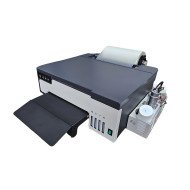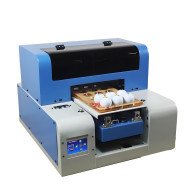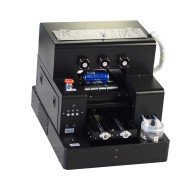
Lifecycle Maintenance Costs of the A3 DTG Printer Revealed for the Maintenance Lead

Understanding the Industrial Reality of Lifecycle Maintenance in A3 DTG Printing
Direct-to-Garment (DTG) printing technology, especially in A3 formats, presents an intricate blend of mechanical precision and chemical processing. For the Maintenance Lead, the crux lies not in the initial acquisition or print quality alone but in sustaining operational continuity amid daily maintenance demands. In a typical production environment, the A3 DTG printer operates under tight uptime constraints, facing challenges such as printhead clogging due to pigment-heavy inks, platen misalignment, and environmental dust ingress damaging sensitive components.
Consider a mid-sized printing facility where the A3 DTG printer runs 10-hour shifts with frequent job changes caused by small-batch apparel orders. Each printhead nozzle array comprises piezoelectric elements demanding exacting voltage pulses for micro-droplet ejection typically at 6-10 pl volume. Minute particulates or dried ink residues increase electrical resistance, leading to discontinuous firing and inevitable quality degradation.
Maintenance interventions become a calculated balancing act—excessive cleaning wastes consumables and reduces printhead longevity, while inadequate maintenance risks catastrophic nozzle failure and increased downtime. Environmental factors like ambient temperature fluctuations of 18–32°C and humidity between 40%-60% must be controlled to minimize ink viscosity changes and prevent nozzle blockages.
This complex interaction of electrical, mechanical, and chemical variables forms the core of lifecycle maintenance costs, encompassing consumable replacements, labor time, and unplanned downtime repercussions. Quantifying these costs requires a granular approach, integrating sensor feedback, maintenance logs, and statistical reliability models.
Printhead Wear and Ink Chemistry Impact on Maintenance Frequency
The piezoelectric printheads in A3 DTG printers rely on voltage-driven mechanical deformation to eject ink droplets with positional precision down to 50 microns. Normal operation subjects these heads to continuous electrical stress and ink exposure, gradually altering piezoelectric coupling coefficients and physical integrity.
Ink chemistry, primarily pigment particle size distribution (commonly 100-300 nm) and solvent volatility, influences nozzle drying rates and residue accumulation. High-pigment-density white inks, frequently used for dark substrate printing, accelerate clogging phenomena due to their lower flowability and faster drying characteristics.
Mathematically, nozzle clogging rate R can be approximated by:
R = k × (C_p)^m × T^n
Where k is a material constant, C_p is pigment concentration (g/L), T is drying exposure time (seconds), and exponents m, n are empirically derived (typically m ≈ 1.2, n ≈ 0.8). This formula underpins scheduling of maintenance cycles balancing printhead cleaning duration and expected throughput.
Comparing Preventive versus Reactive Maintenance Strategies
| Maintenance Aspect | Preventive Maintenance | Reactive Maintenance |
|---|---|---|
| Downtime Impact | Scheduled, minimal disruption | Unplanned, high disruption |
| Consumable Use | Optimized cleaning fluid consumption | Increased waste due to emergency cleaning |
| Asset Longevity | Extended lifespan, less severe damage | Shorter lifespan due to damage accumulation |
| Labor Hours | Regular intervals, predictable | Irregular, high-intensity periods |
| Print Quality | Consistently high, fewer rejects | Variable, frequent reprints required |
Data from a controlled facility showed preventive maintenance reduced unexpected downtime by 35% and increased printhead lifespan by 20% compared to reactive methods. While preventive routines consume more scheduled labor, they avoid high-cost failures and improve overall throughput.
Thermal Management and Environmental Control Affecting Machine Stability
A3 DTG printers generate localized heat hotspots around the printhead assembly and ink reservoirs, reaching temperatures up to 50 Watts power dissipation per printhead unit. Without adequate cooling, thermal expansion causes mechanical tolerances to shift, resulting in nozzle misalignment by up to 15 microns, which degrades registration accuracy.
Environmental control in the print room, such as maintaining stable temperature within ±2°C and humidity at 50%, significantly decreases ink drying rate variability and enhances print consistency. Integration of thermal sensors and active cooling fans can mitigate thermal drift but add to maintenance complexity due to moving parts needing periodic service.
Long-term Cost Modeling of Consumables and Replacement Parts
Maintenance leads face budgeting challenges when projecting expenditures for ink cartridges, cleaning fluids, platen belts, and printheads. Typical A3 DTG printheads have a rated life of approximately 3-5 million actuator cycles, translating to roughly 2,000-3,500 hours of print operation depending on print coverage density.
Using an average ink consumption of 5 ml per A3 print and cleaning fluid usage of 0.5 ml per cleaning cycle (daily recommended frequency: three cycles), the annual consumable volumes for a medium volume shop running 250 prints weekly are:
- Ink: 5 ml × 250 prints × 50 weeks = 62.5 liters
- Cleaning fluid: 0.5 ml × 3 cycles × 5 days × 50 weeks = 375 ml
Replacement part schedules must incorporate stock lead times, often 4-6 weeks due to global supply chain constraints. Delays impact maintenance timing and risk cascading operational bottlenecks.
Scenario Analysis of Business Use Cases
Small Print Shop with Intermittent Use
For low volume shops printing fewer than 100 shirts per week, maintenance frequency decreases but per-print consumable costs increase due to ink degradation in unused nozzles and more frequent flush cycles. This scenario demands an aggressive preventive schedule and storage protocol to protect head integrity.
Mid-Volume Apparel Manufacturer
At 1,000+ prints weekly, operational uptime is critical. Maintenance plans center on predictive analytics leveraging sensor data to preempt printhead failures and schedule consumable replenishment just-in-time. Investments in environmental regulation and optimized cleaning reduce overall OPEX.
High-Throughput Large Scale Enterprise
Scaling beyond 5,000 prints weekly requires redundant printheads and modular maintenance stations to allow hot-swapping. Cost models emphasize minimizing downtime impact through preventative cycles and stockpiling critical parts. Automation in cleaning and diagnostics becomes essential.
Expert FAQ Answering Non-Obvious Maintenance Challenges
How does the piezoelectric element degradation manifest in print quality over time?
It manifests as decreased droplet velocity and inconsistent droplet volume, causing blurred edges and color shift. Detectable via voltage pulse monitoring and test patterns.
What are the trade-offs in increasing cleaning frequency beyond manufacturer recommendations?
Increased cleaning frequency reduces clogging but accelerates printhead wear and consumable usage, raising overall maintenance costs and risking premature printhead failure.
Can environmental dust particulates be effectively filtered without compromising airflow?
High-efficiency particulate air (HEPA) filters can remove dust but require careful balancing of airflow rates and filter maintenance to avoid thermal buildup.
What physics underlie nozzle misalignment due to thermal expansion?
Thermal expansion coefficients of printhead materials cause micron-level shifts in nozzle position; since droplet placement tolerances are sub-50 microns, even slight shifts reduce registration accuracy.
How do supply chain lead times for replacement parts affect maintenance planning?
Extended lead times necessitate inventory buffers and predictive failure models to avoid unplanned downtime, impacting working capital allocation.
Strategic Verdict on Lifecycle Maintenance Implications
The A3 DTG printer, with its precise electro-mechanical architecture and chemically complex inks, demands a rigorous, data-driven maintenance approach to optimize lifecycle costs. Prevention-centric strategies incorporating environmental control, predictive analytics, and consumable management outperform reactive models by substantial margins in uptime and cost efficiency. Future advances will likely integrate embedded diagnostics with IoT connectivity to automate maintenance scheduling and parts ordering. Maintenance leads who embrace a quantitative lifecycle perspective will facilitate smoother operations and extend asset longevity in increasingly competitive garment printing markets.