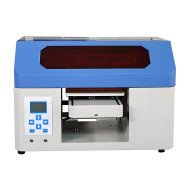
Lifecycle Maintenance Costs and Hidden Bottlenecks of A3 Spot UV Printing Machines Analyzed for Scalable Business Owners
The Industrial Reality of UV Coating Printing at Scale
In medium-sized print production environments, integrating A3 Spot UV Printing Machines involves a complex confluence of operational, technical, and maintenance factors that directly affect overall throughput and profitability. Unlike simple inkjet or laser devices, UV coating printers require rigorous control over curing cycles, substrate handling, and precision spot placement to maintain quality at scale. Business owners aiming to scale workflows from low-volume artisan jobs to high-throughput batch runs often encounter unforeseen bottlenecks that materially impact labor allocation and automation integration.
For instance, an A3 Spot UV printer producing detailed spot coatings on 300gsm card stock at 600 dpi resolution faces critical thermal management challenges as the ultraviolet lamps dynamically heat the substrate surface and printer mechanics. Without optimized airflow or heat dissipation, substrate warping induces registration errors that cascade into heightened reject rates. In a facility targeting 2000 sheets per 8-hour shift, even a 2% downtime due to such registration faults results in a deficit of 40 usable sheets, equating to tangible loss in customer fulfillment and incremental labor needed for quality control interventions.
Moreover, the printer’s ultraviolet LED lamp modules—typically rated for 10,000 operational hours—require scheduled calibration and eventual replacement. In workflows where production planning neglects these lifecycle intervals, print quality inconsistencies emerge, undermining brand reliability. Therefore, proper lifecycle maintenance planning balanced against production demand is essential for operational continuity. This distinct ecosystem of mechanical precision, optical accuracy, and curing chemistry demands continuous monitoring to ensure scale transition does not trigger hidden operational bottlenecks.
Technical Deep Dive into Lifecycle and Throughput Constraints
UV Curing Module Thermal Profiles and Material Stress
The ultraviolet curing module of an A3 Spot UV printer emits radiation in the 365–405 nm range, with power output typically between 30 to 80 W/cm2. The localized thermal load on substrates induces temperature gradients (ΔT) which can be approximated by Fourier's law for heat conduction:
q = -k · A · (dT/dx)
where k is the thermal conductivity of the substrate, A the surface area, and dT/dx the temperature gradient. For 300gsm card stock (thermal conductivity ~0.15 W/mK), a curing lamp of 50 W/cm2 over a 50 mm x 50 mm spot applies substantial local heat flux causing potential substrate expansion of ΔL ~ 5-10 µm over 50 mm, enough to misalign subsequent print passes.
Printhead Actuation and Spot Placement Precision
The precision of spot UV application depends on piezoelectric actuator responsiveness and mechanical rigidity of the print carriage. Actuator latency under load (measured in microseconds) can vary with environmental temperature. In high-throughput environments, actuator drift of even 20 µm leads to cumulative spatial errors, degrading spot coating uniformity. Comparing two actuator designs:
| Specification | Piezo Actuator A | Piezo Actuator B |
|---|---|---|
| Max Displacement | 40 µm | 60 µm |
| Response Time | 15 µs | 12 µs |
| Thermal Drift | ±8 µm/°C | ±5 µm/°C |
Actuator B provides superior precision under fluctuating ambient conditions, important for long print runs.
Ink Rheology and UV Ink Chemistry Impact on Maintenance Cycles
Spot UV inks display viscoelastic behavior strongly dependent on temperature and shear rate. Improper UV lamp intensity or inconsistent curing can result in ink gelation inside nozzles, leading to clog formation. Routine maintenance protocols suggest nozzle purge every 1000 sheets or 8 operational hours, whichever occurs first. Failure to adhere leads to print defects and increased downtime. Quantifying nozzle clog probability as a function of ink viscosity (η) and curing energy density (E):
P(clog) ∝ ek(η - ηcrit) / E
where k is a constant derived empirically, and ηcrit is the critical viscosity threshold.
Infrastructure Integration Challenges Affecting Throughput
Scaling A3 Spot UV printers in production lines requires synchronization with upstream finishing equipment (cutters, folders) and downstream digital asset management systems. Latency in print job transmission or mechanical handover can create queuing delays. Additionally, the electrical power demands of UV lamps peak at 1.5 kW per unit and require stable voltage to prevent output fluctuations. Facilities must therefore incorporate dedicated power conditioning and HVAC adjustments to avoid thermal accumulation that degrades printer electronics.
Asset Depreciation and Maintenance Cost Modeling
Calculating Total Cost of Ownership (TCO) for these machines reveals maintenance as a dominant variable. Initial CAPEX for an A3 Spot UV printer is approximately $45,000. Annual maintenance—including lamp replacements, actuator servicing, and nozzle cleaning—averages $6,000. Factoring in a 5-year depreciation period, annual fixed costs (CAPEX spread) approximate $9,000 plus variable maintenance. Factoring typical operational hours (~2,000 per year) results in an effective cost of $7.50 per operational hour excluding labor. This cost metric assists scalable business owners in benchmarking against throughput targets and labor overhead.
Scenario Analysis of Business Use Cases
Case 1: Mid-Level Print Shop Scaling Seasonal Campaigns
This business processes orders for 500 to 2,000 card stock units during peak seasonal runs. The critical specification is maintaining 600 dpi resolution with 0.1 mm spot registration tolerance. Throughput is bottlenecked by manual substrate loading and lamp warm-up time. Implementation of automated sheet feeders and pre-heating protocols can reduce downtime by 15%, improving output from 1,500 to 1,725 units per shift.
Case 2: High-End Packaging Producer Requiring Micron-Level Spot Accuracy
A luxury packaging facility demands spot UV spot size fidelity to within 20 µm on substrates ranging from 200gsm to 400gsm. Here, the actuator type and thermal stability dominate maintenance scheduling. Upgrading to piezo actuator B and installing supplemental airflow cooling reduces registration defects by 40%, significantly reducing rework costs.
Case 3: Large Scale Print House Integrating Multiple Printing Technologies
This facility uses A3 Spot UV machines in tandem with offset and digital presses. Infrastructure challenges emerge from power load balancing and networked print job management. Investing in dedicated power supplies and implementing real-time print queue monitoring software align throughput with multi-shift labor scheduling, reducing machine idle time from 12% to below 5%.
Expert FAQ on A3 Spot UV Printer Operational Realities
Q1 What are the primary factors causing substrate warping during UV curing?
Localized thermal gradients induced by UV lamps cause differential expansion in substrates. Factors include power density of lamps, substrate thickness, and ventilation. Controlling curing speed and incorporating heat dissipation mechanisms mitigate warping.
Q2 How does actuator thermal drift directly impact printing precision over long runs?
Thermal drift causes mechanical displacement altering printhead position, degrading spot accuracy. Over 8 hours, cumulative drift without compensation can exceed 100 µm, necessitating periodic recalibration or temperature-controlled environments.
Q3 What ink viscosities are optimal for preventing nozzle clogging in spot UV applications?
Optimal viscosities range between 150 and 300 mPa·s at 25°C, balancing flow characteristics and curing speed. Deviations beyond this range increase clog risk or cure failures.
Q4 How does power supply stability correlate with ultraviolet lamp lifespan?
Voltage fluctuations cause lamp intensity variation, accelerating LED degradation. Stable regulated power sources can extend lamp life by up to 30%, decreasing maintenance frequency.
Q5 What maintenance schedule best balances downtime and print quality?
A proactive schedule involving daily nozzle purges, weekly actuator checks, and bi-annual lamp module replacements optimizes uptime while maintaining consistent print quality.
Strategic Verdict on Technology Trajectory and Operational Impact
The A3 Spot UV printing machine occupies a technically demanding niche requiring precise mechanical, optical, and chemical integration. For scalable business owners, understanding lifecycle maintenance costs and hidden operational bottlenecks is critical before capacity scaling. Future technological advances will likely focus on enhanced thermal management, actuator stabilization, and smarter ink chemistry to reduce downtime and extend maintenance intervals. Meanwhile, infrastructure investments in power conditioning and workflow automation remain vital for achieving target throughputs without sacrificing quality. Recognizing these factors early enables operators to optimize asset longevity and maintain competitive operational margins.