Exploring the Gap Between DIY and Industrial Nail Printing

The Industrial Reality
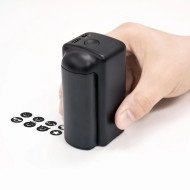
In the world of nail art, the DIY Nail Printer Model 3D offers a unique hybrid experience, situated between personal craftsmanship and industrial-scale printing. This device aims to bridge the technology gap, yet it faces several technical hurdles that need scrutinizing from an industrial perspective.
Technical Deep-Dive
1. Precision vs. Versatility
When evaluating precision, this printer achieves a resolution of 1200 dpi, competing with industrial-grade standards. However, versatility in substrate handling remains a challenge, as it primarily focuses on keratin substrates with limited adaptability to other surfaces.
2. Printhead Mechanics
The printhead employs piezoelectric technology, delivering micro droplets as small as 3 pl. This mimics industrial systems, but its durability under continuous operation shows potential wear concerns.
3. Ink Chemistry
The use of non-toxic, quick-drying inks aligns with safety compliance standards. Yet, the chemical composition primarily supports short-lived designs, contrasting with industrial longevity.
4. Hardware Comparisons
A comparative hardware analysis shows this model operates at 50 Watts, significantly lower than industrial counterparts. This reduced energy consumption implies lower operational costs but may affect overall output speed.
5. Lifecycle Expectations
While the expected lifecycle aligns with similar prosumer models, around 1,000 hours of operation is typical, further highlighting its niche between DIY and full-scale production environments.
Scenario Analysis
Consider a beauty salon evaluating this model. The initial low cost and reduced power requirements present an attractive ROI, fostering ease of integration. However, the limited substrate versatility and printhead durability concerns may require frequent replacements.
For home enthusiasts, it delivers salon-quality precision without the industrial overhead. Yet, maintenance requires technical familiarity akin to professional devices.
A school of beauty technology could leverage this for educational purposes, demonstrating the trade-offs between industrial and DIY scales.
Expert FAQ
- How does the printhead durability compare? Comparable to entry-level industrial models, yet it may require more frequent checks.
- What substrates are supported? Primarily optimized for nails, with limited versatility for other materials.
- Can it operate continuously? Short bursts are ideal; continuous operation may lead to overheating.
- How does ink consumption compare? Less efficient than industrial systems, potentially increasing long-term costs.
- What are typical maintenance cycles? Regular checks every 100 hours of operation are advised.
Strategic Verdict
Positioned between personal and professional realms, it offers significant advantages for niche applications. Nonetheless, its industrial application is constrained by limited substrate compatibility and durability concerns. The roadmap suggests a niche future in bridging DIY creativity with industrial robustness.