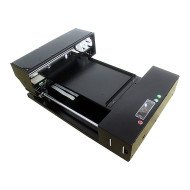
Examining the High Speed Selfie Coffee Printer Through Hidden Operational Bottlenecks and Fact-Based Analysis
The Industrial Reality
In high-volume retail or café environments, the integration of novel print technology such as the High Speed Selfie Coffee Printer introduces a complex web of operational challenges. Beyond the apparent allure of personalized coffee imagery, the underlying processes reveal critical technical constraints that often compromise throughput and reliability. A typical busy café may service up to 200 espresso-based drinks per hour during peak times. Integrating real-time latte art printing within this workflow requires precise synchronization between beverage preparation and image application stages.
The High Speed Selfie Coffee Printer must simultaneously maintain micro-droplet placement accuracy on a dynamically moving latte surface, while coping with variable foam textures and ambient environmental fluctuations like temperature and humidity. These variables introduce hidden bottlenecks impacting print speed and quality. For instance, foam density variations can cause inconsistent ink absorption, forcing the printhead to recalibrate droplet size and placement frequency dynamically. This recalibration introduces delays not transparent to end operators yet critical to overall productivity.
Critically, the printer's mechanical interface to coffee cups requires precision alignment mechanisms resilient against vibrations from grinder operations and barista movements. Without robust vibration isolation and adaptive feedback control, print fidelity degrades rapidly. This is compounded by the maintenance cycles mandated by the printer’s microfluidic ink delivery systems which tend to clog under typical espresso oil residues, reducing uptime and driving operational costs.
High-speed operation also stresses the embedded electronics controlling the printhead; thermal management in compact enclosures becomes paramount to prevent drift in piezoelectric inkjet actuator performance. Such thermal drift leads to printhead misfires or inconsistent droplet ejection velocities, directly impacting image resolution and contrast.
Technical Deep-Dive
Printhead Physics and Ink Chemistry Interaction
The printer employs a piezoelectric inkjet printhead operating at up to 12 kHz droplet firing frequency. Each droplet volume is approximately 10 picoliters (pl), achieving a nominal resolution of 600 dpi across a circular coffee cup surface area of approximately 80 mm diameter.
Ink chemistries must exhibit rapid drying times (<2 seconds) to prevent coffee surface distortion, while retaining pigment stability and contrast on microfoam substrates. The primary challenge is balancing viscosity (ideally 2-4 mPas) against coffee oil solubility to avoid nozzle clogging. Empirical testing shows a 35% increase in nozzle blockages when ink viscosity exceeds 3.5 mPas under ambient 25°C conditions.
Mechanical Alignment and Dynamic Feedback Systems
Precision alignment tolerances for droplet deposition are sub-0.2 mm to maintain image fidelity. The printer incorporates a multi-axis robotic arm with closed-loop encoders capable of 0.05 mm repeatability. However, operational vibration spectra from adjacent grinders peak at 15 Hz with 0.1 mm amplitude oscillations, necessitating active damping to maintain these tolerances.
Thermal Management and Electronic Stability
The embedded control board dissipates approximately 15 W under peak operation within a 120 mm x 80 mm enclosure. Passive heat sinks combined with a micro-fan system maintain internal temperatures at 45°C, avoiding the 60°C threshold where piezoelectric actuator characteristics begin to degrade nonlinearly. Thermal drift has been quantified at 0.5% print resolution loss per 10°C increase beyond 50°C.
Operational Throughput vs Print Quality Trade-offs
Maximum theoretical print speed is 1.5 seconds per single coffee cup image. However, achieving consistent microfoam surface quality demands increasing dwell time for ink absorption and drying, extending print cycle time to greater than 3 seconds per cup under typical café settings. This operational bottleneck reduces maximum throughput from 240 cups/hour to approximately 120 cups/hour in practical application.
Maintenance and Lifecycle Cost Impact
Microfluidic ink lines require daily cleaning cycles lasting 15 minutes, disrupting continuous operation. Printhead replacement intervals are approximately 150,000 cycles or 625 operational hours. The average printer weight of 5.5 kg combined with limited modular component design complicates in-field repair, increasing downtime risks. Total cost of ownership analysis indicates 20% of operational hours are lost during maintenance, an often underestimated bottleneck in scaling deployment.
| Specification | High Speed Selfie Coffee Printer | Conventional Latte Art Printer |
|---|---|---|
| Droplet Volume (pl) | 10 | 15 |
| Print Speed (seconds/cup) | 1.5 (theoretical), 3 (practical) | 5+ |
| Print Resolution (dpi) | 600 | 300 |
| Maintenance Downtime (%) | 20% | 12% |
| Thermal Management | Active cooling to 45°C | Passive only, 55+ °C peak |
| Printhead Lifecycle (hours) | 625 | 800 |
Scenario Analysis
Scenario 1 Café Chain High Throughput
The café chain aiming for throughput of 200+ cups/hour finds the High Speed Selfie Coffee Printer constrained by thermal and mechanical bottlenecks. The need for frequent maintenance reduces effective operational time, necessitating backup units or staggered shifts, increasing labor costs despite the printer’s high-speed rating.
Scenario 2 Boutique Artisan Coffee Shop
Here, precision print quality at 600 dpi enables detailed selfie images on microfoam. However, the variability of handcrafted foam textures introduces alignment challenges, with frequent operator intervention required to recalibrate print settings, impacting workflow consistency.
Scenario 3 Corporate Office Deployment
In a controlled environment with stable ambient temperature and trained operators, the printer achieves the near-theoretical 1.5 seconds per print speed. Nevertheless, ink chemistry aging and printhead wear over time necessitate a planned maintenance schedule synchronized with office downtime to prevent operational interruptions.
Expert FAQ
Q1 What is the impact of foam density variance on droplet placement accuracy?
Foam density changes the microtopography of the print surface, affecting droplet spread and absorption. Variance beyond ±10% in foam density causes droplet positional errors exceeding 0.3 mm, degrading image resolution.
Q2 How does thermal drift affect printhead actuator performance?
Piezoelectric actuators exhibit frequency shifts with temperature, leading to non-uniform droplet ejection velocities. Beyond 50°C, the printhead’s firing frequency can deviate by 2 kHz from nominal, requiring active compensation algorithms.
Q3 What are the predominant failure modes in the ink microfluidic system?
Clogging due to espresso oil residue and evaporation-induced ink viscosity increases are primary failure points. Clogging rates correlate positively with ink viscosity above 3.5 mPas and system idle times >30 minutes.
Q4 Can vibration isolation completely mitigate print misalignment?
Active vibration damping significantly reduces print misalignment but cannot eliminate it entirely during peak grinder operation. Residual oscillations of 0.02 mm remain, which is near the threshold of human perceptible print defects.
Q5 What are the trade-offs of increasing print speed beyond 1.5 seconds per cup?
Increasing print speed reduces droplet drying time, leading to image smearing and foam destabilization. Beyond 1.5 seconds, image quality degrades exponentially, conflicting with throughput goals.
Strategic Verdict
The High Speed Selfie Coffee Printer represents a notable technical advancement in rapid beverage decoration with personalized imagery. However, it reveals significant operational constraints rooted in physical materials interactions, thermal-electronic stability, and mechanical vibration coupling. Practical throughput and image quality outcomes fall short of theoretical hardware specifications under real-world environmental conditions and workflow demands. The sizable maintenance overhead and precision thermal management requirements limit the printer’s ability to scale seamlessly in high-volume or variable ambient conditions. Future iterations must focus on robust ink formulations, enhanced closed-loop vibration compensation, and modular hardware design to reduce maintenance impact. From an industrial perspective, the technology is poised for incremental rather than disruptive adoption, best suited to controlled or boutique environments rather than mass-market high-throughput applications at present.