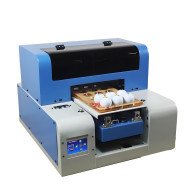
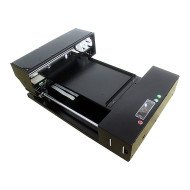
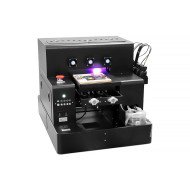
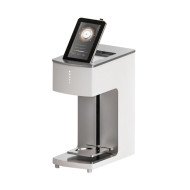
Analyzing Hidden Operational Bottlenecks of the A3 DTG Printer T-shirt Printing Machine for the Scalable Business Owner

The Industrial Reality of Scaling DTG Printing Operations
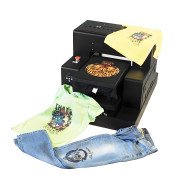
The adoption of A3 Direct-to-Garment (DTG) printers for T-shirt production has surged among scalable business owners seeking automation and throughput improvements. However, despite the compact footprint and seemingly straightforward operation, the actual industrial environment reveals multiple challenges that can inhibit efficiency and profitability. A critical bottleneck emerges in balancing speed, printhead wear, and ink consumption while maintaining precise color fidelity on varied substrates. These constraints often manifest in unexpected downtime, throughput limitations around 120 garments per 8-hour shift, and escalating operational costs driven by consumable waste and equipment wear.
For example, when ramping production from prototype to moderate batch sizes, the manual pre-treatment process and cooldown cycles enforce latency that reduces overall machine utilization below 65%. Furthermore, the embedded printhead technology, typically employing piezoelectric nozzles with 6-12 pl droplet sizes, faces clogging risks exacerbated by pigment-laden aqueous inks. This creates maintenance windows that consume approximately 10-15% of nominal operational time weekly, directly impacting labor costs and delivery guarantees. The scalability imperative for business owners thus hinges on understanding these hidden operational bottlenecks impacting sustained print run productivity.
Printhead Physics and Throughput Constraints
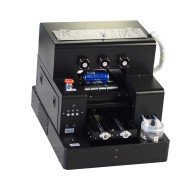
The A3 DTG printer usually integrates a piezoelectric printhead array optimized for high-resolution output, typically maxing out at 1200 dpi with 6-12 picoliter droplet size. The physics of ink ejection involve induced pressure waves within micro-chambers, ejecting droplets through nozzles less than 20 micrometers in diameter. While this allows excellent image fidelity, smaller droplet sizes and nozzle dimensions increase the susceptibility to clogging especially with pigment-based inks used on cotton fabrics.
Operational throughput calculations illuminate limits: assuming a print area of 297 mm x 420 mm, a 1200 dpi resolution equates to roughly 14,160 x 16,536 pixels. At an ideal drop placement rate of 8 kHz per nozzle and approximately 128 nozzles per color channel, theoretical max print time per T-shirt exceeds 4.5 minutes. Realistically, accounting for printhead cleaning cycles every 50 prints, and curing times, effective throughput drops to approximately 10-12 shirts per hour under continuous operation.
Ink Chemistry and Maintenance Impact on Uptime
DTG inks, largely pigment-based aqueous solutions, present maintenance challenges due to particle sedimentation and nozzle clogging. The chemistry requires precise pH stabilization and surfactant balance to maintain fluidity and prevent drying in micro-channels. Businesses scaling toward high volume operations see a maintenance burden manifesting as daily automated cleaning cycles lasting 20-30 seconds per print cycle, and manual nozzle purging weekly. These affect uptime and ink utilization, with up to 25% of ink wasted in purge cycles.
Comparing pigment versus reactive dye inks, pigment inks offer superior wash durability but increase printhead wear. Reactive dyes, while faster drying and less clog-prone, limit fabric compatibility and longevity. Selecting inks thus involves trade-offs between operational uptime, substrate versatility, and long-term maintenance costs.
Infrastructure Integration Challenges in Automated Environments
Integrating the A3 DTG printer into high-throughput automated workflows requires addressing thermal management, curing station synchronization, and workflow software compatibility. The printer consumes approximately 120 Watts during printing but spikes to 500 Watts during cleaning and curing phases requiring dedicated power circuits. Rack density planning must consider ventilation and access for maintenance to avoid heat buildup that accelerates printhead degradation.
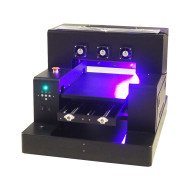
Post-print curing, typically via integrated infrared or UV lamps, demands precise timing to prevent heat damage to substrates or distortion. Synchronizing this with conveyor and pre-treatment systems remains a bottleneck in automated line setups, especially given the cooling period needed after curing. Software architectures must handle color management profiles and variable print layouts dynamically to prevent manual intervention, yet many scalable businesses report integration friction between DTG hardware and ERP print management systems.
Operational Cost Modeling and Asset Longevity
From a financial control perspective, analyzing Total Cost of Ownership (TCO) reveals the A3 DTG printer’s asset depreciation over a 5-year horizon tied tightly to consumable costs and maintenance downtime. Initial CAPEX averages $15,000 - $20,000, whereas ink costs alone can exceed $0.30 per shirt depending on coverage and color density. Scheduled cleaning and printhead replacement every 18 months cost $2,000 - $3,000 in parts and labor.
Calculating labor costs for downtime and manual interventions, the effective cost per print increases by 12-18% beyond consumables. Extended asset longevity demands preventive maintenance regimes and operational discipline often overlooked in scaling scenarios. Failure to address these hidden costs inflates OPEX and reduces competitive margins.
| Specification | A3 DTG Printer (Standard) | Alternative Industrial DTG Setup |
|---|---|---|
| Max Resolution | 1200 dpi | 1440 dpi |
| Print Speed | 10-12 shirts/hr | 20-25 shirts/hr |
| Ink Type | Pigment-based aqueous | Reactive dye or pigment hybrid |
| Maintenance Cycle | Daily cleaning; 18 months printhead replacement | Automated cleaning; 24 months replacement |
| Power Consumption | 120W printing; 500W cleaning/curing | 150W printing; 450W curing optimized |
Scenario Analysis for Scalable Business Owners
Case 1: Small Batch Custom Prints
Businesses focused on short-run personalized orders benefit from the A3 DTG’s high resolution but face bottlenecks with pre-treatment and cooldown times, limiting throughput to 8-10 shirts per hour. Maintenance cycles are manageable but operational costs remain high per unit, challenging profitability at scale.
Case 2: Mid-Volume Production Runs
Scaling to 100-300 shirts per day reveals the hidden costs of maintenance downtime and ink wastage. The manual logistics around pre-treatment and post-print curing demand labor overheads that erode margins unless additional automation is introduced.
Case 3: High-Volume Industrial Integration
Integrating multiple A3 DTG units into an automated line confronts infrastructure bottlenecks in thermal management and software orchestration. High power spikes during cleaning/curing phases challenge electrical stability and rack density. Printhead wear accelerates without advanced preventive maintenance, increasing unplanned downtime.
Expert FAQ on Operational Bottlenecks
What printhead clogging mitigation strategies exist beyond automated cleaning?
Periodic manual purging with specialized solvents, using ink formulations with enhanced anti-settling agents, and controlled humidity environments help reduce clogging frequency. In-line ultrasonic cleaning technologies are emerging but not yet widespread.
How does substrate variation impact throughput?
Heavier or pre-treated fabrics require longer drying and curing times, extending print cycle durations by up to 30%. This reduces hourly throughput significantly, necessitating workflow adjustments or parallel printing stations.
What are the thermal management requirements for scalable DTG setups?
Maintaining ambient temperatures between 20-25°C with relative humidity around 50% optimizes ink performance and printhead lifespan. Forced air ventilation with heat extraction at curing stations prevents heat-induced damage and printhead overheating.
Are there firmware solutions for dynamic print layout to reduce idle times?
Advanced DTG controllers support variable data printing but integration with ERP systems is often proprietary. Middleware solutions facilitate dynamic layout generation but require custom development and testing.
What are the cost implications of switching to reactive dye inks?
Reactive dyes lower maintenance costs due to reduced clogging but limit fabric compatibility and colorfastness. Ink costs may be lower by up to 20%, but potential reprints due to color fade reduce long-term savings.
Strategic Verdict on Operational Bottlenecks in A3 DTG Printing
The A3 DTG printer offers a technically robust entry point for scalable T-shirt printing but carries inherent operational bottlenecks in printhead maintenance, throughput, and workflow integration. Successful scaling depends on rigorous maintenance protocols, infrastructure upgrades focusing on thermal and power management, and software automation to reduce manual interventions. These factors significantly influence the Total Cost of Ownership and asset longevity. Future advancements in printhead design, ink chemistry, and integrated curing methods will be critical to elevating throughput and reducing downtime for scalable businesses aiming to move beyond niche production toward moderate industrial volumes.