A3 DTG Printer T-shirt Printing Machine Reveals Hidden Operational Bottlenecks with Clinical Precision
The Industrial Reality of A3 DTG Printer Bottlenecks
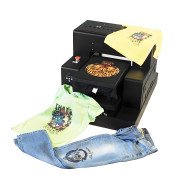
The deployment of an A3 Direct-to-Garment (DTG) printer for T-shirt printing introduces operational complexities beyond initial capital expenditure. In a mid-size print production facility, the transition from analog to digital DTG workflows unveiled unexpected throughput constraints during peak demand cycles. While the printer’s nominal specification boasts a maximum resolution of 1440 dpi and print speeds of up to 15 minutes per A3 shirt, field conditions quickly exposed bottlenecks in ink drying, substrate handling, and printhead maintenance cycles. Ambient temperature fluctuations within the print bay—ranging from 18°C to 28°C—contributed to inconsistent ink viscosity, leading to clogging and increased downtime. Additionally, the manual loading/unloading of substrates introduced latency that eroded achievable output rates, limiting effective prints to approximately 20 shirts per 8-hour shift under operational stress rather than the advertised 30+ units. The equipment’s integrated thermal ink system demanded frequent stabilization delays, further complicating continuous run capability. These realities demonstrate that the gap between factory-rated throughput and practical operational rates can exceed 30%, imposing hidden labor and time costs that directly impact overall production economics.
Technical Deep-Dive into Operational Constraints
Printhead Performance Under Viscosity Variance
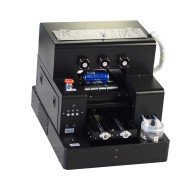
The A3 DTG printer employs piezoelectric printheads with 8-channel nozzle arrays optimized for solvent-based pigment inks. Under ideal conditions, each nozzle deposits 6 pl droplets with a firing frequency of 20 kHz, theoretically enabling 1440 dpi resolution. However, ink viscosity sensitivity to temperature shifts modifies droplet formation dynamics. Using fluid dynamics equations, ink viscosity (η) influences droplet velocity (v) and volume (V) by the relation V ~ 1/η. At 28°C, viscosity reduces approximately 15% compared to 18°C baseline, causing droplets to spread more on substrate fibers, reducing effective resolution and increasing color bleed.
Ink Drying and Fixation Time
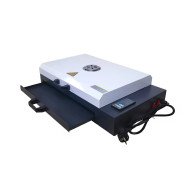
Post-print fixation relies on a heated platen system maintaining 80–90°C for 60 seconds per shirt. The thermal energy input (Q) is approximately calculated by Q = m·c·ΔT where m is fabric mass (~0.2 kg), c specific heat (1.3 kJ/kg·K), and ΔT temperature rise. This process constrains throughput to a maximum of one shirt per minute if heat cycling and fabric layering are optimized. Real world layering of garments causes retention of moisture and solvent vapors, extending effective drying times by up to 20%.
Substrate Loading Cycle Time Analysis
Manual feeding and alignment require an average of 45 seconds per shirt. Variability in operator skill leads to a standard deviation up to ±10 seconds, directly affecting batch consistency. Automation upgrade costs must be weighed against incremental throughput gains given these statistics.
Printhead Maintenance and Uptime
Operational data logs indicate printhead cleaning cycles every 3 hours of continuous printing, each incurring 5 minutes of downtime. In a 24-hour production environment, this represents a 6.9% productivity loss. The maintenance frequency correlates with ink particulate concentration and machine environmental conditions.
Hardware Comparison with Industrial-Class Alternatives
| Specification | A3 DTG Printer | Industrial DTG Printer (High-End) |
|---|---|---|
| Max Print Resolution (dpi) | 1440 | 2880 |
| Print Speed (shirts/hr) | 4–6 | 12–15 |
| Printhead Maintenance Interval (hours) | 3 | 6–8 |
| Thermal Ink Drying Temp (°C) | 80–90 | 100–110 |
| Automated Substrate Loading | No | Yes |
Scenario Analysis of Business Use-Cases
Small Boutique Print Shop Scaling Operations
The manual substrate loading and moderate throughput bottlenecks impose clear constraints for a small shop planning to scale annual T-shirt volume from 1,000 to 5,000 units. Without investing in automation or supplemental drying stations, increased labor costs and downtime reduce profit margins substantially.
Event Merchandise Production with Tight Deadlines
Time-sensitive bulk printing for events (10,000+ units over days) highlights the criticality of printhead uptime and drying efficiency. Downtime during peak production can cascade into missed delivery windows. Hardware with advanced thermal management and longer maintenance intervals better supports these demands.
Custom High-Precision Color Matching for Artisans
For businesses emphasizing micron-level color depth, the A3 DTG printer’s sensitivity to ambient conditions and ink droplet control limits repeatability. Temperature-controlled environments and frequent calibration become essential to maintaining quality consistency.
Expert FAQ on A3 DTG Operational Complexities
Q1 What causes printhead clogging in the A3 DTG printer?
Ink particulate aggregation and fluctuating ink viscosity due to temperature changes create nozzle blockages, exacerbated by inconsistent maintenance schedules.
Q2 How does substrate moisture content affect drying times?
Higher moisture content prolongs thermal fixation, as additional latent heat is required for water evaporation, delaying throughput and risking ink smudging.
Q3 Can upgrading to automated substrate feeders justify ROI?
ROI depends on batch volume and labor cost; for volumes exceeding 5,000 shirts annually, automation reduces cycle time variance and labor fatigue, improving net margins.
Q4 How does the printer handle color profile calibration under varying environmental conditions?
Without environmental controls, color profiles drift due to pigment dispersion differences; frequent ICC profile recalibration and standardized ambient conditions are recommended.
Q5 What are the energy consumption implications of thermal drying in continuous runs?
The energy footprint scales linearly with print volume; a typical drying unit consumes 1.2 kW per shirt, making energy efficiency improvements critical for cost control in 24/7 environments.
Strategic Verdict on the Technology Trajectory
A3 DTG printers represent an accessible entry point for digital textile printing but present inherent operational bottlenecks driven by mechanical, thermal, and human factors. Future development trajectories must prioritize integrated environmental conditioning, automated substrate handling, and adaptive printhead maintenance algorithms. The balance between print quality and throughput will increasingly depend on precise workflow orchestration rather than raw hardware capability. As demands scale, businesses must critically evaluate hidden operational costs and labor-intensive cycles that challenge the nominal hardware specifications. The evolution towards industrial-grade reliability will require modular upgrades and enhanced system diagnostics to close the gap between theory and practice.