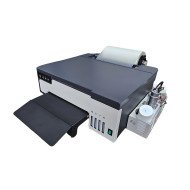
The Gap Between DIY and Industrial Grade Explored Through the A3 Roll DTF Printer

The Industrial Reality of the A3 Roll DTF Printer in Advanced Print Environments
The production environment for direct-to-film (DTF) printing, especially at the A3 roll size, reveals significant operational tensions between DIY-style desktop solutions and true industrial-grade equipment. Consider a mid-sized textile printing workshop aiming to scale from low-volume custom orders to a continuous 24/7 run. The technical challenge is clear: achieving repeatable, high-fidelity output without frequent interruptions or costly downtime. This environment exposes the fragile boundary between hobbyist equipment and machines built for sustained industrial utilization.
Initial tests of an A3 Roll DTF printer often demonstrate promising image sharpness and color saturation at 600 dpi. Yet, within weeks of operation, inconsistencies surface in film adhesion, printhead clogging, and color gamut fidelity. These challenges are frequently rooted in component tolerances, firmware controls, and consumable lifecycle metrics that differentiate DIY-grade mechanisms from industrial designs. The presence of complex variable parameters – rolling tension, ink viscosity, ambient temperature stability – place a premium on hardware design robustness and engineered control systems uncommon in hobbyist models.
Moreover, rolling continuous film substrates necessitate precision mechanical handling. A misaligned roller system by merely 0.1 mm can induce skewing detectable at the micron level, which critically impacts transfer accuracy during curing. The cumulative effect degrades throughput and introduces quality control bottlenecks, often unnoticed in simple flatbed printer setups. Consequently, a granular assessment of each system component, from motor drive fidelity to inkjet nozzle durability under industrial load, is essential for understanding the real operational boundaries of A3 Roll DTF printers.
Technical Deep Dive into the Core Hardware and Operational Limits
Mechanical Transport Precision and Film Handling
The A3 roll DTF printer features a continuous feed mechanism designed to transport thin PET films with a nominal thickness of 100 microns. The rollers must maintain lateral and longitudinal alignment within ±0.05 mm to ensure consistent print registration. Deviations introduce shear forces and micro-wrinkles detectable under 10x magnification, which impact print clarity. The choice of stepper motors with 0.1° incremental positioning versus industrial-grade servo motors with encoder-feedback loops makes a measurable difference in registration precision.
Inkjet Printhead Performance Under Continuous Operation
Printheads commonly utilize piezoelectric or thermal bubble technology. Piezoelectric heads, with droplet volumes of 4-10 pl, provide finer control of drop size but may experience nozzle wear after 1000 operational hours, resulting in nozzle clogging and jetting instability. Thermal bubble heads, while cost-effective, suffer from accelerated thermal stress and require more frequent head replacements in 24/7 production cycles. Maintaining a working temperature band between 30-40 °C minimizes ink viscosity fluctuation critical for jet stability.
Ink Chemistry and Film Adhesion Challenges
DTF inks require complex pigment dispersion in polymerizable binders to achieve optimal opacity and color vibrancy on transparent PET films. Ink viscosity is typically maintained between 10-15 cP at 25 °C. Subtle deviations in binder crosslinking kinetics during curing affect film adhesion and wash fastness. Industrial-grade printers incorporate inline UV or heat curing modules calibrated to deliver 150-200 mJ/cm2 dosage uniformly, whereas DIY setups may rely on inconsistent manual curing.
Firmware Control and Print Optimization Algorithms
Advanced firmware algorithms dynamically adjust firing sequences to compensate for nozzle clogging, color drift, and environmental temperature changes. A3 Roll DTF printers with industrial controllers implement closed-loop feedback from optical sensors to detect film stretch and compensate in real-time. Open-loop firmware in hobbyist models lacks these features, leading to offset errors accumulating over long runs.
Data Analysis of Throughput Versus Print Quality
Consider two operational scenarios measured over 1000 meters of printed film:
| Parameter | DIY-Grade A3 Roll DTF | Industrial-Grade A3 Roll DTF |
|---|---|---|
| Average Print Speed (m/min) | 1.2 | 2.8 |
| Color Consistency (Delta E <2) | 65% | 95% |
| Downtime % due to clogging | 18% | 4% |
| Film Waste % | 12% | 5% |
| Average Uptime (hours) | 6 | 21 |
The contrast underscores operational bottlenecks hidden within lower-tier equipment impacting yield and quality, pinpointing the critical design and engineering investments that separate industrial-grade units from their DIY counterparts.
Scenario Analysis of Business Use Cases Impacted by Printer Specification
Small Batch Custom Apparel Production
For artisanal clothing manufacturers focusing on limited runs, color depth and substrate versatility trump raw speed. A DIY A3 Roll DTF printer can deliver sufficient precision for under 100 prints weekly, but lacks consistency in maintaining color uniformity across batches. Substrate thickness variability leads to frequent printhead cleaning cycles, increasing downtime and labor costs.
Mid-Level Print Service Provider Scaling Volume
Companies servicing local businesses with orders ranging from 500 to 2000 prints monthly require throughput and uptime to be predictable. Industrial-grade A3 Roll DTF printers allow continuous runs with minimal intervention, supported by firmware automation and robust mechanical design. These features reduce labor overhead and improve turnaround times significantly compared to DIY setups.
High-Volume Direct-to-Garment Integration
Enterprise environments integrating DTF as a component of a multi-printer workflow demand high reliability and minimal variation. The ability of industrial A3 Roll DTF printers to integrate with inline curing and cleaning stations and support advanced RIP software with color management ensures operational scalability without sacrificing quality. The enhanced mechanical precision reduces substrate waste and print errors contributing to cost efficiencies.
Expert FAQ on Technical Nuances of A3 Roll DTF Printers
Q1 What are the main failure modes of DTF printheads in continuous roll applications?
Primary failure modes include nozzle clogging due to pigment settling, piezoelectric diaphragm fatigue causing droplet volume drift, and thermal damage from overheated ink. Industrial-grade printers mitigate these through automated cleaning cycles and environmental controls.
Q2 How does substrate thickness variation impact registration accuracy?
Variations above ±15 microns alter the film stiffness, causing slippage or skew during feeding. This results in color misalignment especially during multicolor passes, more pronounced in DIY machines with less precise film handling.
Q3 What ink curing parameters optimize adhesion without substrate deformation?
Curing at 160-180 °C for 20-30 seconds or UV energy between 150-200 mJ/cm² achieves optimal polymer crosslinking. Excess heat induces film shrinkage, warping designs. Industrial printers control these parameters precisely with integrated curing systems.
Q4 Can firmware real-time feedback loops compensate for mechanical deviations?
Yes, closed-loop systems utilize optical sensors to detect minor film stretch or skew, dynamically adjusting printhead timing and carriage position within ±10 microns, a feature absent in hobbyist printers.
Q5 What are the measurable operational impacts of environmental temperature fluctuations?
Temperature swings of ±5 °C affect ink viscosity and droplet formation, leading to visible banding and color shifts. Industrial systems incorporate heating elements and sensor-controlled environments maintaining ±1 °C stability.
Strategic Verdict on the Future Trajectory of A3 Roll DTF Printers
The divide between DIY and industrial-grade A3 Roll DTF printers is anchored in mechanical precision, thermal and firmware control sophistication, and consumable lifecycle management. Moving forward, tighter integration of sensor feedback and adaptive firmware will progressively narrow gaps in print fidelity and throughput. However, the capital expenditure and engineering complexity required to maintain continuous run stability and color consistency will preserve industrial-grade solutions as a necessity for scaling enterprises. The evolution will lean on modular architectures enabling incremental upgrades to core subsystems such as curing, ink delivery, and mechanical transport, reinforcing the primacy of industrial-grade designs for mission-critical print production workflows.