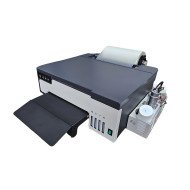
The Financial Audit Reveals Hidden Costs in A3 Roll DTF Printer Workflows

The Industrial Reality of Cost Accumulation in DTF Printing
Consider a mid-sized print shop acquiring an A3 Roll Direct To Film (DTF) printer aiming to boost their custom textile production. On the surface, the capital expenditure (CAPEX) appears manageable given the printer’s advertised throughput and print quality. However, a detailed audit quickly exposes layers of operational expenditures (OPEX) often overlooked in initial budgeting. These costs ripple through daily workflows impacting profitability and asset depreciation rates.
DTF printing, while technologically advanced, demands specific consumables and maintenance procedures that introduce hidden financial strain. Ink consumption rates, particularly for white underbase layers, escalate rapidly and require frequent replenishment. Film roll costs vary regionally but are fundamentally non-negotiable recurring expenses. Additionally, the printer’s complex mechanical and printhead systems necessitate scheduled upkeep to prevent unexpected downtime or costly repairs. Such factors conflate to reduce asset utilization efficiency below theoretical maximums.
This financial audit examines these variables rigorously to expose the true cost profile of operating an A3 Roll DTF printer within a standard production environment. The objective is to align expenditure visibility with operational realities to empower decision-makers seeking sustainable return on investment (ROI).
Technical Deep-Dive into Workflow Cost Drivers
Ink Consumption and Usage Efficiency
DTF printers typically utilize pigment-based inks with high pigment density, especially in white inks used for underbase layers. Assuming an A3 print area of 297 x 420 mm and a standard coverage rate of 80%, average ink consumption can be estimated:
Ink Volume per Print = 297 mm x 420 mm x 0.8 x Ink Layer Thickness (approx. 15 microns)
Calculating volume gives 297 x 420 x 0.8 x 0.015 mm = 1503.12 mm³ or 1.503 mL (assuming ink density ~1 g/mL). For a daily run of 100 prints, white ink alone consumes approximately 150 mL, with comparable volumes of CMYK inks. Considering retail ink costs averaging $150 per liter for white, daily ink cost for white ink is roughly $22.50, excluding CMYK.
Film Roll Cost and Usage Rates
Film rolls sized for A3 width and 50-meter length cost approximately $70–$90 per roll. The film usage per print is approximately 0.0125 m² (0.297 m x 0.42 m). Each roll covers about 15 m², translating into roughly 1200 prints per roll. Film cost per print is approximately $0.06 to $0.08, consistent but significant over large runs.
Scheduled Maintenance and Downtime Impact
Printheads in DTF printers confront abrasive pigment inks which gradually degrade nozzles. Maintenance cycles often recommend nozzle cleaning every 500 prints to maintain quality, each requiring 15 minutes of labor and use of cleaning solvent (~$5 per session). Unplanned downtime due to clogging averages 2 hours quarterly, directly impacting throughput and increasing indirect labor costs.
Energy Consumption and Thermal Management
Operating power averages 300 watts during active printing and 100 watts in standby. A 10-hour production day results in ~2.5 kWh daily consumption. At an industrial rate of $0.12/kWh, daily energy costs approximate $0.30. While minor relative to consumables, energy adds up over time.
Asset Depreciation and Resale Value
High-use DTF printers depreciate rapidly due to printhead wear and advances in ink technology. A typical 3-year straight-line depreciation for an asset priced at $12,000 results in monthly depreciation expense of $333. However, operational wear factors and obsolescence often force accelerated depreciation beyond book calculations.
| Cost Element | Estimated Per Print Cost | Impact on Workflow |
|---|---|---|
| White Ink | $0.225 | Highest consumable expense; critical for print quality |
| Film Roll | $0.07 | Stable but recurring cost; regional price variance exists |
| Maintenance Labor | $0.063 (15 min/500 prints) | Essential to uptime; labor-intensive with solvent costs |
| Energy | $0.003 | Minimal but cumulative operational cost |
| Depreciation | $1.11 (monthly basis) | Significant fixed cost; accelerated by wear and tech cycles |
Scenario Analysis of Cost Impact on Diverse Business Models
Case 1 Small Boutique Print Shop
Operating 50 prints per day, focusing on high-margin custom garments. Consumable costs heavily influence pricing strategy, with a need for tight ink management. Maintenance labor costs are modest but downtime severely impacts customer lead times, limiting throughput.
Case 2 Medium-Sized Apparel Manufacturer
Daily run of 400 prints, leveraging volume discounts on films and ink. Bulk consumable procurement reduces per-print costs but maintenance escalates, requiring dedicated technicians. Asset depreciation and replacement cycles become major budget components.
Case 3 Large Contract Printing Facility
High-volume output exceeding 2000 prints daily across multiple shifts. Automation in material handling reduces labor costs but increases energy consumption. Maintenance scheduling optimized to minimize downtime, but printhead replacements incur significant capital costs. Thin profit margins demand continuous cost auditing.
Expert FAQ with Technical Nuances
How does pigment particle size affect printhead longevity?
Smaller pigment particles (~100 nm) reduce nozzle abrasion but require advanced ink formulations. Larger particles increase clog risks and accelerate wear, shortening printhead lifecycle.
What variables most impact white ink consumption efficiency?
Print coverage ratio, layer thickness, and curing parameters influence white ink usage. Optimizing for minimal layer thickness without compromising opacity yields savings.
How can maintenance schedules be optimized to balance uptime and quality?
Data-driven predictive maintenance utilizing nozzle health monitoring sensors improves scheduling over fixed intervals, reducing unnecessary cleaning cycles.
Are there advances in film materials that lower per-print costs?
Research into thinner films with enhanced tensile strength reduces material consumption and waste, but market-ready options remain limited.
What impact does regional energy cost variation have on total cost of ownership?
While energy costs are minor, prolonged printing hours in high-cost regions may justify investment in energy-efficient or alternative technologies to control OPEX.
Strategic Verdict on the Financial Viability of A3 Roll DTF Printers
The A3 Roll DTF printer presents an attractive entry point for digital textile printing, with competitive throughput and image fidelity. However, the financial audit reveals that consumable expenses, particularly white ink and film, dominate per-print cost structures. Maintenance labor and asset depreciation further erode profitability if unmanaged.
Future improvements in ink chemistry and film technology are critical to reducing OPEX pressures. Operational workflows benefiting from data-driven maintenance and bulk procurement strategies show potential for better ROI. Decision-makers must integrate these hidden costs into financial models and plan for accelerated depreciation cycles when selecting this technology for scalable production environments.