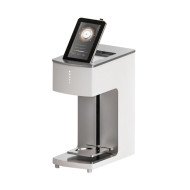
Smart Mini A4 UV Printer Performance Limits and Operational Realities for Scalable Businesses
The Industrial Reality of Miniature UV Printing in High-Volume Environments
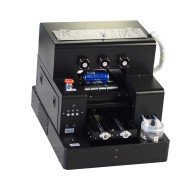
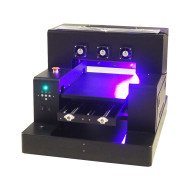
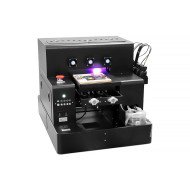
In high-throughput production settings, integrating a compact UV printer such as the Smart Mini A4 necessitates careful scrutiny against operational bottlenecks. The challenge lies in balancing the printer's miniature form factor with the rigors of continuous multi-shift use. Small-scale UV printers often experience accelerated wear on mechanical components due to thermal cycling and printhead firing frequencies. For scalable business operations focused on volume, the Smart Mini A4's constrained throughput—typically calibrated for sheet sizes up to 210 mm by 297 mm—presents an immediate capacity ceiling. While the UV curing process enables rapid substrate solidification, the cycle time per print must be weighed against job scheduling demands, especially when substrate changeover and ink replenishment add non-printing downtime. The printer's compact UV lamp assembly and integrated optics are designed for precision but may limit print speed without compromising cure quality or color fidelity, impacting throughput when compared to larger industrial-grade models.
Additionally, the device’s footprint and ergonomics influence workflow integration. The mechanical chassis and feeder mechanisms, although space-efficient, introduce alignment tolerances that require heightened maintenance vigilance to prevent cumulative positioning drift during extended runs. In multi-device setups, synchronization challenges emerge due to limited communication protocols typical of compact UV printers, potentially necessitating additional automation layers to harmonize throughput.
Printhead and Ink System Constraints in Mini UV Printers Compared to Industrial Counterparts
Inkjet UV printers rely on piezoelectric printheads capable of ejecting ink droplets in picoliters (pl). The Smart Mini A4 employs printheads optimized for small-area prints with droplet sizes likely in the 10-20 pl range, favoring fine resolution at the expense of volumetric throughput. By contrast, industrial UV printers utilize multiple staggered printheads covering larger swaths, achieving speeds upwards of 10,000 mm/min at 600 dpi resolutions. The single-pass or bi-pass configuration of the Smart Mini restricts layer deposition rate, which directly affects drying kinetics and substrate compatibility.
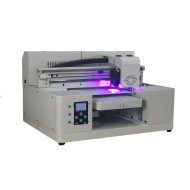
The UV ink formulation for the Smart Mini A4 is engineered for rapid photopolymerization under compact LED-UV lamps, typically emitting wavelengths near 395 nm. While this enables energy-efficient curing, the limited irradiance power—often measured in mW/cm²—means thicker or more pigmented ink layers require multiple passes or slower print speeds to ensure full polymerization. This trade-off impacts production velocity and throughput consistency in high-demand scenarios.
| Specification | Smart Mini A4 UV Printer | Industrial UV Printer |
|---|---|---|
| Maximum Print Area (mm) | 210 x 297 | 800 x 600+ |
| Print Speed (mm/min at 600 dpi) | ~500-1000 | 8000-12000 |
| Droplet Size (pl) | 10-20 | 20-40 |
| UV Lamp Power (mW/cm²) | ~20-40 | 80-150 |
| Substrate Thickness (mm) | Up to 10 typical | Up to 50+ typical |
Thermal and Mechanical Stress Impact on Long-Term Printhead Reliability and Maintenance
The interplay between thermal load and printhead piezoelectric element fatigue in mini UV printers is critical. The Smart Mini A4’s limited cooling system—usually a passive heat sink combined with compact fans—must manage the heat generated by frequent firing cycles and UV lamp operation. Excessive thermal stress can accelerate printhead failure modes such as nozzle clogging, piezo crystal depoling, and channel delamination. Furthermore, ink viscosity and particulate load directly influence nozzle jetting stability, requiring controlled ambient humidity and temperature to minimize print defects.
Regular maintenance cycles for cleaning and recalibration are more frequent in compact units due to constrained component tolerances. The compact mechanical feeder introduces additional wear points, with mechanical backlash and substrate feeding misalignment leading to cumulative print quality degradation over weeks of continuous use. Maintenance teams must plan for incremental downtime and consumable replacement scheduling to sustain uptime targets in production workflows.
Infrastructure Integration Challenges with Mini UV Printers in Automated Production Lines
Integrating the Smart Mini A4 UV printer into automated production lines requires addressing data communication protocols and power management limitations. Unlike enterprise-grade printers with industrial Ethernet, proprietary real-time OS, and precise external synchronization triggers, the Smart Mini A4 often relies on USB or basic network connections without native line speed feedback or external error reporting. This necessitates secondary systems for job queuing and quality control.
Power-wise, the mini UV printer’s compact UV LED sources and compact printheads draw relatively low wattage (estimated 50-150 Watts peak), which eases thermal management demands. However, voltage stability and transient protection are crucial to prevent printhead malfunctions induced by power fluctuations typical in industrial settings. Active monitoring of environmental dust and substrate particulate also influences uptime, often requiring external filtration units.
Operational Cost and Throughput Trade-offs for Scalable Business Implementation
The economic challenge with the Smart Mini A4 UV printer lies in the marginal throughput gains versus incremental operational complexity when scaled beyond prototyping or low-volume production. While the initial capital expenditure is significantly lower than full-size industrial UV printers, the per-unit time cost increases due to slower print speeds and frequent maintenance. The rapid depreciation of consumables such as UV inks, printheads, and UV lamps must be factored into total cost of ownership (TCO).
Labor allocation for routine maintenance and substrate handling impacts operational expenditure (OPEX). The absence of full automation capabilities requires manual interventions that accumulate labor hours. Conversely, the compact footprint allows deployment in constrained environments, lowering facility costs. Businesses must weigh throughput ceilings against labor and downtime costs to assess ROI realistically in scaling scenarios.
Scenario Analysis of Business Models Utilizing the Smart Mini A4 UV Printer
Case 1 Small Batch Customization for Niche Markets
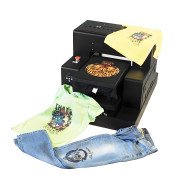
For businesses focused on niche product customization—such as bespoke promotional items or limited-run packaging—the Smart Mini A4’s precision and size offer benefits. The printer can handle diverse substrates without extensive retooling and supports highly detailed graphics at 600 dpi. The throughput limitations are less critical in low-volume runs, enabling rapid job changes with low ink waste. Cost per print remains competitive due to lower initial investment and minimal floor space.
Case 2 Mid-Scale Production with Frequent Job Variation
Firms requiring moderate production volumes with frequent artwork changes face bottlenecks. The print speed and substrate handling constrain throughput, creating backlog under demand spikes. The operator workload for job setup and maintenance increases, eroding labor efficiency. Bottlenecks develop especially during color-intensive or thick ink layer jobs requiring multiple passes.
Case 3 Integration into High-Volume Automated Lines
In large-scale manufacturing, deploying numerous Smart Mini A4 units in parallel can mitigate individual throughput limitations but increases complexity exponentially. The lack of native automation interfaces demands custom systems for synchronization and quality control. Operational costs rise from maintenance frequency and labor input. The unit’s small print area limits applicability to small components or secondary printing tasks rather than primary production.
Expert FAQ on Mini UV Printer Operational and Technical Challenges
Q1 What is the critical failure mode for printheads under continuous operation?
The primary failure mode is piezoelectric material fatigue leading to inconsistent droplet ejection, compounded by nozzle clogging from polymerized ink residue due to incomplete UV curing at high speeds.
Q2 How does ambient temperature affect UV ink viscosity and print quality?
Temperature fluctuations alter ink viscosity dynamically; higher temperatures reduce viscosity improving flow but risk nozzle flooding, while lower temperatures increase viscosity causing misfires and clogging.
Q3 What maintenance interval optimizes uptime without excessive consumable expenditure?
Empirical data suggests a calibrated preventive maintenance every 150 operating hours balances downtime and consumable lifespan, subject to usage intensity and substrate variability.
Q4 Can the Smart Mini A4 UV printer handle substrate thickness variation without recalibration?
Substrate thickness beyond ±2 mm from nominal specifications generally requires manual recalibration of Z-axis height and focus to maintain print fidelity.
Q5 Is it feasible to retrofit the printer with higher power UV LEDs to increase throughput?
Increasing UV lamp power without redesigning thermal management and power regulation risks component overheating and printhead damage; such retrofits require comprehensive hardware validation.
Strategic Verdict on Mini UV Printers in Scalable Business Environments
The Smart Mini A4 UV printer embodies a trade-off between compactness and throughput that defines its role in scalable production. Its strengths in precision and low footprint make it viable for small-batch and customization applications where speed is secondary. However, the technical and operational constraints impose significant limits on continuous high-volume operations without substantial investment in supplementary automation and maintenance resources. Going forward, advances in printhead durability, integrated real-time diagnostics, and enhanced UV LED power management may incrementally push the performance ceiling. Until then, enterprises targeting scale must carefully quantify throughput bottlenecks, maintenance overhead, and integration complexity before deploying these mini UV solutions at scale.