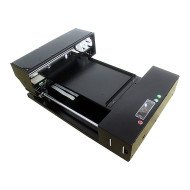
PrintInd Ultra Portable Handheld Inkjet Printer Exposes Hidden Operational Bottlenecks in High-Precision Workflows

The Industrial Reality of Using a Handheld Inkjet Printer in Complex Production Settings
Integrating a handheld inkjet printer like the PrintInd Ultra Portable within established industrial workflows highlights numerous latent operational challenges. Although marketed for portability and convenience, its deployment in environments requiring consistent, high-precision output demands rigorous scrutiny. Consider a quality control station in a manufacturing line stamping batch numbers on irregular or moving surfaces. The ergonomic design and handheld nature might suggest ease of use, but the reality involves operator fatigue, uneven print placement, and susceptibility to environmental variables such as vibration or inconsistent surface texture. These factors combine to create throughput bottlenecks that are less visible but materially affect production timelines.
Moreover, the intermittent connectivity and manual positioning mean that the rate of defects escalates when scaling operations beyond prototype or low-volume production runs. The PrintInd’s reliance on user steadiness and on-the-fly calibration can be at odds with the high repeatability demanded in industrial asset marking or traceability logging. This creates pressure to introduce redundant checks or post-print scanning, adding hidden labor overheads that erode any productivity gains from the device’s portability.
The surface conformity challenge also surfaces when applying ink on substrates with variable curvature or micro-textures. Without precise mechanical guidance or stabilizing mounts, droplet placement accuracy and droplet size distribution vary, resulting in inconsistent print density or legibility—issues insidiously undermining quality assurance programs.
Technical Deep-Dive on PrintInd Ultra Portable Inkjet Printer’s Operational Constraints
Printhead Design and Precision Challenges
The PrintInd employs a piezoelectric inkjet head optimized for low-power handheld use. While piezo printheads typically achieve droplet sizes in the 10-30 picoliter range, the effective resolution is constrained by human-induced micro-movements during printing. Assuming a nominal 300 dpi (dots per inch) baseline, operator hand jitter introduces positional inaccuracies exceeding 0.2 mm—equivalent to nearly 5 dpi deviation—degrading the theoretical resolution.
Ink Chemistry and Drying Dynamics
The ink vehicle is formulated for rapid drying on a variety of substrates. However, handheld operation exposes prints to ambient airflows and contaminants that increase variability in drying times, ranging from 0.5 seconds on smooth metals to over 3 seconds on porous composites. This variability affects adhesion and durability, necessitating frequent calibration of ink viscosity and print speed. Mathematical modeling of drying kinetics suggests a critical balance must be maintained between print frequency (Hz) and drying intervals to avoid ink pooling or smudging.
Battery Life and Thermal Management
Powering the PrintInd relies on lithium-ion cells sized for a maximum continuous operating time of 2.5 hours. Each print cycle consumes approximately 15 W, with thermal dissipation limited by the handheld form factor. Without active cooling, operating temperatures stabilize near 45°C under continuous use, risking thermal drift in piezo actuator responsiveness. The lack of thermal sensors limits automatic correction, potentially shifting printhead alignment by up to 0.1 mm during extended runs.
Operational Throughput and Human Factors
Maximizing throughput demands minimizing operator fatigue and maximizing accuracy. Ergonomic analysis reveals the average user can sustain accurate prints for approximately 20 minutes before performance degradation occurs. Human factors engineering indicates peak throughput is capped at approximately 120 individual prints per hour, limited by repositioning time and error correction.
Data Connectivity and Workflow Integration
The device connects via Bluetooth Low Energy (BLE) for print data transfer, with pairing and latency averaging 300 ms per command. This wireless link introduces an occasional 2% failure rate in data transmission, requiring manual reprint commands that extend workflow time and increase error logs. Compared with tethered industrial inkjet printers offering 1 Gbps Ethernet connections and sub-millisecond latency, this bottleneck challenges integration in highly automated environments where timing synchronization is critical.
| Feature | PrintInd Ultra Portable | Industrial Fixed Inkjet Printer |
|---|---|---|
| Print Resolution | 300 dpi (effective ~295 dpi due to hand jitter) | 600-1200 dpi |
| Print Speed | ~120 prints/hour (manual operation) | Up to 2000 prints/hour (automated) |
| Power Consumption | 15 W (battery powered) | 75-150 W (mains powered) |
| Thermal Management | Passive, handheld limited | Active cooling and sensors |
| Connectivity | Bluetooth Low Energy, 300 ms latency | Ethernet, <1 ms latency |
Scenario Analysis Applying PrintInd Specifications to Diverse Business Models
Small Batch High-Mix Production
For artisan workshops producing limited edition items with varying substrates, the PrintInd offers significant flexibility. The handheld design supports direct marking on uniquely shaped workpieces without complex fixturing. However, the throughput limits and user fatigue factors restrict the practical batch size to low hundreds per shift before inefficiencies mount. The 300 dpi baseline is adequate for standard branding but may fall short for intricate microtext or secure markings.
Field Service and Asset Management
The portable nature suits field technicians needing to mark or label infrastructure components in situ. The trade-off here favors mobility over print quality; however, environmental challenges such as dust, moisture, and inconsistent power supply strain the device’s robustness. Maintenance intervals shorten due to ink nozzle clogging under variable conditions, raising lifecycle costs.
High-Volume Manufacturing Line Integration
Attempting integration into assembly lines reveals critical bottlenecks. Manual operation and limited connectivity incompatibility impose delays that conflict with equipment cycle times. The risk of print errors increases with operator variability. Automated fixed inkjet systems remain the standard for this use case given their deterministic performance and advanced sensory feedback mechanisms.
Expert FAQ Unpacking Advanced Technical Aspects
Q1 What are the primary failure modes in the PrintInd’s piezo printhead under heavy use?
Piezo printheads suffer from piezoelectric element fatigue, nozzle clogging due to particulate contamination, and polymer ink residue buildup. Under handheld conditions with irregular cleaning cycles, the risk of clogging increases significantly.
Q2 How does hand-induced micro-motion quantitatively affect droplet placement accuracy?
Micro-movements introduce positional deviations typically modeled as Gaussian noise with a standard deviation of ~0.2 mm. This noise reduces effective dpi and increases the probability of overlapping or misaligned dots, impacting legibility.
Q3 How can ink drying times be optimized without changing ink chemistry?
Environmental controls such as localized airflow, temperature stabilization, and humidity control reduce drying variability. Software-driven print intervals can be adjusted to allow sufficient drying between passes based on real-time sensor feedback.
Q4 What maintenance protocols best extend handheld printer longevity?
Regular nozzle cleaning cycles, real-time clog detection, and cartridge replacement aligned with usage hours are critical. User training on optimal storage and handling further mitigates premature failures.
Q5 What integration challenges arise from BLE data transmission compared to wired Ethernet?
BLE introduces higher latency, lower bandwidth, and intermittent connectivity. This necessitates error-correction protocols, buffering, and manual oversight, complicating real-time automated workflows.
Strategic Verdict on the PrintInd Ultra Portable’s Future in Industrial Contexts
The PrintInd Ultra Portable Handheld Inkjet Printer embodies a niche convergence of mobility and flexibility, yet it exposes inherent operational bottlenecks when deployed beyond small-batch or fieldwork scenarios. Its limitations in print precision, throughput, thermal regulation, and data communication highlight the gap between convenience-focused portable devices and deterministic industrial inkjet systems. Future iterations would need to address error mitigation through advanced stabilization, improved connectivity, and integrated environmental sensing if they aim to encroach on automated, high-volume production environments. For now, it finds pragmatic application in controlled low-volume settings where portability trumps absolute precision and speed.