Analyzing Hidden Operational Bottlenecks in A4 Roll DTF Printers for Scalable Business Owners
The Industrial Reality
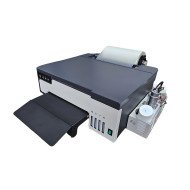
Small-scale production facilities transitioning to scalable printing workflows face acute challenges integrating A4 Roll Direct-to-Film (DTF) printers. Although marketed as streamlined and versatile, these printers can conceal operational bottlenecks that directly limit throughput and automation potential. In a mid-sized textile decorating enterprise aiming to scale orders from 50 to 500 garments daily, even minor inefficiencies become amplified. The narrow format width of an A4 roll restricts maximum printable area per pass, requiring multiple feed cycles per design. This elongates print job queues and strains labor allocation for loading films and managing prints.
Additionally, the drying and powder adhesion phases intrinsic to DTF workflows introduce wait times that significantly affect uptime. When machine cycle times clash with post-processing capacity, printers idle, creating throughput gaps. For an owner seeking to replace manual screen-print workflows with semi-automated digital production, these capacity ceilings manifest as hidden costs. These include increased labor hours for interim handling, unexpected maintenance triggered by workflow interruptions, and cascading delays in finishing processes such as heat pressing and curing. Without thorough bottleneck analysis, these constraints remain masked behind advertised print speeds or resolution specs.
Moreover, A4 Roll DTF printers often leverage consumer- or prosumer-grade components to maintain cost competitiveness. This choice impacts reliability under high-duty cycles. Printheads optimized for smaller batch runs and less intense ink demands may degrade prematurely at elevated volumes. Combined with precise film tensioning requirements and powder distribution mechanisms, maintaining consistent print quality demands rigorous process controls. These technical challenges converge into a scenario where planned scale-up efforts encounter unplanned resource drains, both human and mechanical.
Understanding and quantifying these bottlenecks becomes essential for sustainable expansion. Only through methodical technical evaluation can a scalable business owner navigate these operational hidden costs and align expectations with real-world capacity.
Technical Deep-Dive
Roll Width and Print Area Efficiency
A4 paper width is approximately 210 mm, limiting the printable width on roll DTF printers to a similar dimension. For comparison, wider roll widths (e.g., 330 mm or 420 mm) can print more designs per pass. Assuming a design width of 200 mm and a substrate width clearance of 210 mm, each print cycle handles a single design across the film width.
To quantify throughput: If a print head operates at 2400 dpi across 210 mm, the print head must traverse approximately 1984 dots (210 mm * 240 dpi / 25.4 mm). Print speed at 12 m/min yields a line rate of roughly 500 mm/s. The single-design pass thus takes a minimum of:
Time per design pass = (Design length in mm) / (Print speed in mm/s)
For a 300 mm design length, time = 300 mm / 500 mm/s = 0.6 seconds print time per line, but with multiple passes needed for color layers and curing.
Ink Usage and Printhead Wear Rates
DTF printers employ water-based pigment inks; droplet size generally ranges from 4-6 picoliters (pl). For a 210 mm wide roll with 600 dpi vertical resolution, pixel count per cm^2 approximates 144,000. Multiply by ink per droplet yields total ink load per print. Increased daily print volume exponentially increases ink consumption, accelerating printhead degradation.
Drying and Powdering Cycle Constraints
After printing, the wet ink film requires precise drying at 60-80°C for 1-2 minutes to set the design before powder application. Powder adhesion mandates uniform particle size (~30-50 microns) and even distribution to prevent print defects. The open-loop timing of drying and powdering stages introduces bottlenecks, especially if powder adhesion is uneven or drying temperature fluctuates beyond ±5°C, affecting ink cure consistency.
Automation Integration Challenges
Automation systems must synchronize film feeding, powder application, curing, and final substrate transfer. The A4 size restricts batch size per roll, requiring frequent roll changes or manual intervention. Conveyor speed mismatches between print and curing stations induce queuing or idle periods. A feedback loop for tension control is necessary to avoid film wrinkling, which degrades print head nozzle health.
Maintenance Intervals and Failure Modes
Printhead clogging is the leading failure mode, exacerbated by fine ink particle settling and powder contamination. Planned maintenance intervals range between 500-1000 print hours, but under high throughput stress, unplanned shutdowns can occur as frequently as every 200 hours. Consumables like capping station wipers and filters also limit uptime. Predictive maintenance derived from performance telemetry can extend operational cycles.
| Parameter | A4 Roll Width DTF Printer | Industry 420 mm Roll Width DTF Printer |
|---|---|---|
| Max Printable Width (mm) | 210 | 420 |
| Single Pass Design Count | 1 | 2 |
| Print Speed (m/min) | 12 | 15 |
| Maintenance Interval (Print Hours) | 500-1000 | 800-1500 |
| Average Ink Drop Size (pl) | 4-6 | 4-6 |
| Typical Drying Time (s) | 60-120 | 30-90 |
Scenario Analysis
Scenario 1: Boutique Textile Shop Scaling Semi-Automatically
A boutique operation using an A4 Roll DTF printer prioritizes color vibrancy and rapid sample turnaround. The 210 mm width limits batch size, but the smaller format reduces initial capital outlay and floor space. However, bottlenecks appear in powder application consistency and drying cycles, requiring manual quality checks that reduce effective throughput by 20%. Equipment runs at 70% capacity, and labor costs rise due to manual interventions.
Scenario 2: Medium Enterprise Transitioning from Screen Printing
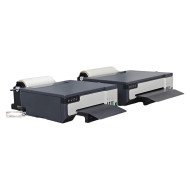
Here, the owner deploys multiple A4 Roll DTF units to compensate for width limitations. Synchronizing multiple lines becomes complex, and downtime from printhead maintenance multiplies across units. Powder adherence uniformity becomes a challenge as environmental humidity varies across a large facility, further increasing defect rates. The operational bottlenecks reduce anticipated labor savings and complicate inventory management.
Scenario 3: On-Demand Customization Kiosk
In a retail or event kiosk environment focusing on rapid, on-demand custom prints, the A4 Roll DTF printer fits well due to compact size and modular integration. The primary bottleneck is the drying and powdering stage, which imposes a minimum wait time of 2 minutes per print. This limits throughput during peak demand, necessitating queue management software or multiple printers for scaling. The trade-off is acceptable given size constraints and customization focus.
Expert FAQ
What impacts printhead lifespan most in high-volume A4 Roll DTF printing?
Printhead lifespan is most affected by frequent nozzle clogging caused by ink particle settling and powder contamination. Regular purification and optimized ink viscosity help extend life, but inherent duty cycle limits remain.
How does film tension control affect print quality and maintenance?
Precise film tension prevents wrinkling and misregistration, which can cause nozzle damage and print defects. Implementing closed-loop sensor feedback mechanisms is critical to sustaining throughput and reducing maintenance intervals.
What are the risks of scaling A4 Roll DTF printers without automation upgrades?
Risks include increased labor costs, higher defect rates due to manual handling, bottleneck accumulation at drying/powdering stages, and accelerated equipment wear from inconsistent workflows.
How do environmental conditions impact powder adhesion consistency?
Humidity and temperature fluctuations influence powder particle behavior and adhesion uniformity. Controlled environmental conditions with ±2°C and <50% relative humidity optimize powder binding and reduce print defects.
Can print speed be increased by lowering dpi without impacting quality?
Reducing dpi from 2400 to 1200 can double print speed but sacrifices image quality, especially fine color gradients and edge sharpness. The trade-off depends on end-use requirements and acceptable quality thresholds.
Strategic Verdict
A4 Roll DTF printers present a constrained but targeted solution in scalable textile printing scenarios. Their narrow roll width and process-imposed drying/powdering timing define a throughput ceiling that is challenging to surpass without parallelization or automation investments. Printhead and maintenance limitations necessitate rigorous workflow optimization to minimize downtime. For scalable business owners, these factors crystallize into hidden operational costs that must be carefully quantified before committing to volume ramp-ups. The technology trajectory points toward incremental improvements in component durability, enhanced automated drying systems, and better environmental controls rather than radical form factor expansions. This measured evolution aligns with the niche role A4 Roll DTF printers occupy—bridging artisanal flexibility with moderate scale rather than full industrial production.