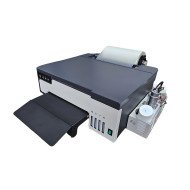
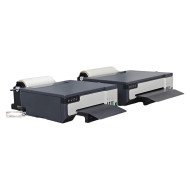
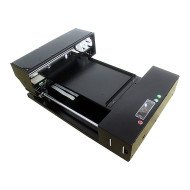
A4 Roll DTF Printer Exposes Hidden Operational Bottlenecks in Textile Printing
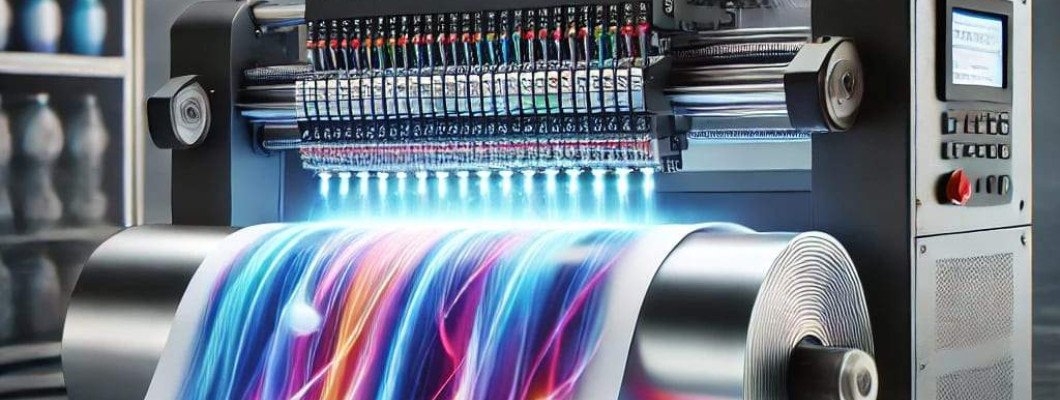
The Industrial Reality of A4 Roll DTF Printers in Production Environments
In high-throughput textile printing facilities, the adoption of A4 Roll Direct to Film (DTF) printers introduces a complex array of operational challenges often overlooked in vendor specifications. Consider a mid-sized print shop scaling from prototype to small batch production using an A4 DTF printer. The printer’s compact form factor and roll-fed mechanism ostensibly promise efficiency. Yet, when integrated into continuous workflows, persistent bottlenecks emerge: frequent film roll replacements, intermittent printhead clogging due to specialized ink chemistry, and thermal curing inconsistencies that directly impact print adhesion and durability. These technical impediments not only prolong downtime but also erode throughput targets. Furthermore, the alignment precision necessary for consistent color registration across the film roll imposes additional mechanical strain on the transport system, accelerating wear on feed rollers and leading to gradual substrate misfeeds.
The operational demands amplify under extended shifts, where heat dissipation from the printer’s printhead assembly contributes to elevated internal temperatures that accelerate ink viscosity shifts and particle agglomeration within nozzles. In such scenarios, maintenance cycles must be recalibrated beyond manufacturers’ standard recommendations. These often hidden operational bottlenecks reduce effective output and complicate predictive maintenance scheduling, leading to higher-than-expected operational expenditure despite a seemingly low initial capital outlay.
Technical Deep-Dive into Bottlenecks and Their Underlying Causes
Printhead Stress and Failure Modes
The A4 Roll DTF printer typically employs piezoelectric printheads capable of ejecting inks at drop volumes ranging from 3 to 10 picoliters. Each nozzle faces mechanical stress due to the cyclical firing frequency, often exceeding 40 kHz in high-speed modes. This induces fatigue in the piezo crystals and increases the risk of nozzle misfires or full blockage. The small form factor constrains thermal management components, causing local hotspots. Assuming continuous operation, the localized temperature rise (ΔT) can be estimated by ΔT = P/(kA), where P is the power dissipation (~3W per printhead segment), k is the thermal conductivity of printhead materials (approx. 150 W/m·K for silicon), and A is the effective heat spread area (around 1 cm²). Limited heat spread leads to ΔT often exceeding 30°C above ambient, exacerbating ink drying inside nozzles.
Ink Chemistry Challenges and Nozzle Clogging
DTF inks are pigment-based with polymer additives designed for adhesion during the curing phase. These additives increase ink viscosity and raise the propensity for nozzle sedimentation. Over time, particles agglomerate, forming micro-crystals that obstruct nozzle orifices. Empirical data from similar pigment systems suggest particle sizes around 200 nm with a zeta potential near −20 mV, indicating moderate stability but vulnerability to temperature-induced flocculation during printhead heating cycles.
Film Transport Mechanics and Tension Control
Maintaining precise substrate tension is critical to avoid wrinkles and maintain registration accuracy. The A4 roll width (~210 mm) demands tension control within ±2 N to prevent slippage or over-stretching, which affects dot placement at 600 dpi (dots spaced ~42 μm apart). Stepper motor microstepping combined with closed-loop feedback from tension sensors achieves this, yet hardware tolerances cause a cumulative positioning error of up to 0.1 mm per meter of film—exceeding the threshold for color misalignment in multilayer prints.
Thermal Curing System Efficiency
After printing, the film passes through a curing unit employing infrared lamps or hot-air tunnels operating at 150–180°C for 20–30 seconds. Thermal uniformity is critical: a 5°C variance across the film can cause uneven polymerization, compromising print adhesion and washing fastness. Computational fluid dynamics (CFD) simulations indicate that airflow velocity needs to be maintained at 3 m/s evenly distributed to prevent hot or cold spots, which is challenging in compact curing modules.
Maintenance Intervals and Downtime Modeling
Industry practice benchmarks printhead cleaning cycles at every 2 hours of operation. However, in the A4 roll DTF printer’s constrained architecture, clogging incidents statistically occur every 90 minutes. With an average manual cleaning time of 20 minutes and a preventative head replacement cycle at 1800 operating hours, downtime accumulates significantly. Financial impact can be modeled as:
Downtime Cost (USD) = (Operating Hours / 1.5) * (20 min / 60) * Labor Cost Rate + (Operating Hours / 1800) * Printhead Replacement Cost
This formula highlights hidden operational costs that offset the printer’s attractive initial CAPEX.
Scenario Analysis of Business Outcomes with the A4 Roll DTF Printer
Scenario One Small Artisan Print Studio
Using the printer for bespoke, low-volume products with a focus on color vibrancy benefits from pigment ink capabilities and micron-level dot accuracy. However, operational bottlenecks reduce batch turnaround by 15%, necessitating additional buffer time for maintenance and film handling.
Scenario Two Mid-Scale Textile Decorator
Scaling to 8-hour production shifts, tension control inconsistencies cause up to 5% rejects due to misalignment. Maintenance frequency requires scheduling internal labor to avoid unplanned stoppages, indirectly impacting throughput and labor overheads.
Scenario Three Industrial Apparel Manufacturer
Integration into a multi-line production rack reveals limitations in thermal curing uniformity, mandating supplementary external curing stations, increasing floor space utilization and energy consumption by roughly 20% beyond initial forecasts.
Expert FAQ with Technical Focus Beyond the Obvious
What is the impact of microdroplet volume variability on color accuracy?
Microdroplet inconsistencies between 3 and 10 pl introduce optical density fluctuations, affecting color gamut reproduction and print uniformity, especially noticeable in gradient transitions. Calibration routines must adjust firing voltage and waveform to stabilize volume within ±0.5 pl.
How does substrate thermal expansion affect print registration during curing?
Polymeric films expand at a coefficient of approximately 70 ppm/°C, leading to measurable dimensional drift during curing cycles that can exceed 0.2 mm on a 210 mm film width, requiring real-time registration compensation algorithms.
Can frequent thermal cycling degrade printhead piezo elements?
Repeated thermal cycling between ambient and 180°C exposure accelerates piezo crystal microfracturing, potentially reducing lifespan by 25% compared to isothermal operation due to thermomechanical stress accumulation.
What are the long-term effects of polymer additive sedimentation in inks on nozzle performance?
Sedimentation reduces nozzle aperture integrity, necessitating either aggressive periodic chemical flushing or printhead replacement, increasing maintenance downtime and consumable costs.
How does limited roll width constrain throughput scalability?
The A4 width restricts maximum print area per pass, requiring multiple overlapping passes for larger garments, which compounds mechanical stress and increases potential for cumulative registration errors.
Strategic Verdict on the A4 Roll DTF Printer’s Operational Position
While the A4 Roll DTF printer presents an accessible entry point for digitized textile decoration with precise print capabilities, hidden operational bottlenecks challenge its viability in scaled production environments. Engineering constraints in thermal management, substrate handling, and printhead durability demand rigorous maintenance regimes and workflow adjustments that impact net throughput and operational expenditure. Therefore, its strategic deployment aligns better with niche artisanal or limited-run applications rather than broad industrial-scale manufacturing. Continued refinement of ink formulations, enhanced substrate tension feedback systems, and improved modular thermal curing units are essential to mitigate these bottlenecks and extend asset longevity.
| Parameter | Current A4 Roll DTF Printer | Industrial-Grade Wide Format DTF Printer |
|---|---|---|
| Maximum Print Width | 210 mm | 800 mm |
| Printhead Drop Volume | 3-10 pl | 3-10 pl (multiple heads) |
| Thermal Management | Passive cooling with limited heat spread | Active cooling with heat sinks and fans |
| Substrate Tension Control | Closed loop ±2 N accuracy | Closed loop ±0.2 N accuracy with servo motors |
| Average Maintenance Interval | 90 min cleaning cycles | 120 min cleaning cycles with auto flush |
| Throughput | Up to 4 m2/hr | Up to 15 m2/hr |